Women’s History Wednesday · Genealogy Research
Francisca Montreuil
The Baker Who Bought Her Children Out of Slavery
By The Kinstructure Company · June 24, 2026 · 9 min read
Francisca Montreuil was never famous, and that is precisely the problem, because she was foundational in a way the famous rarely are. Most people who study Black New Orleans reach first for Marie Laveau, since legend always travels faster than ledgers, and the woman who actually shows you how free people of color built wealth in Spanish Louisiana was never in the legend at all. She was in the notarial record the entire time, filed under two different names, leaving a paper trail that runs without a break from the price of her own freedom all the way to the division of her estate.
Her name was Francisca Montreuil, though the records also carry her as Fanchon Montreuil. She was born in Louisiana around 1733, enslaved from birth, and she died a free woman in New Orleans in 1803. Between those two dates the surviving documents let us watch an entire sequence unfold in order, as skilled labor produced income, as that income freed her children, and as their freedom hardened into an estate that passed cleanly to the next generation. That sequence is the whole point, and in her case the full chain of it survives inside a single file, which is rare enough to be worth saying out loud.
She was never famous, but she was foundational, and we are calling her by name.
The Freedom Sequence
She was a baker, listed in the Spanish records as panadera. She was enslaved by Don Roberto Montreuil, and she was the daughter of Francisco Rancontre and Susana.
In 1775, when she was somewhere near thirty nine years old, she paid eight hundred pesos toward freedom for herself and for her daughter Naneta, the woman the records would later carry as Ana Cadis, with a further amount that remained attached to the arrangement and was canceled roughly a year afterward. By 1777 she had assembled another three hundred pesos and used it to buy freedom papers for her son Carlos, a twenty year old pardo blacksmith, and reading the two transactions side by side makes her method unmistakable. She freed her family the way a person pays down a debt, in deliberate installments, and she financed every one of those installments with money the bakery earned.
The mechanism deserves to be stated plainly, because it is easy to flatten into something softer than it was. The baking itself never freed a single person, but the baking produced pesos, and those pesos became capital, and that capital is what purchased the freedom papers that carried her children out of bondage. The order of it matters, with the trade coming first, then the cash, and then the liberty bought outright, and the skill in her hands was the engine that drove the whole arrangement toward the thing she actually wanted.
A Portfolio, Not a Survival
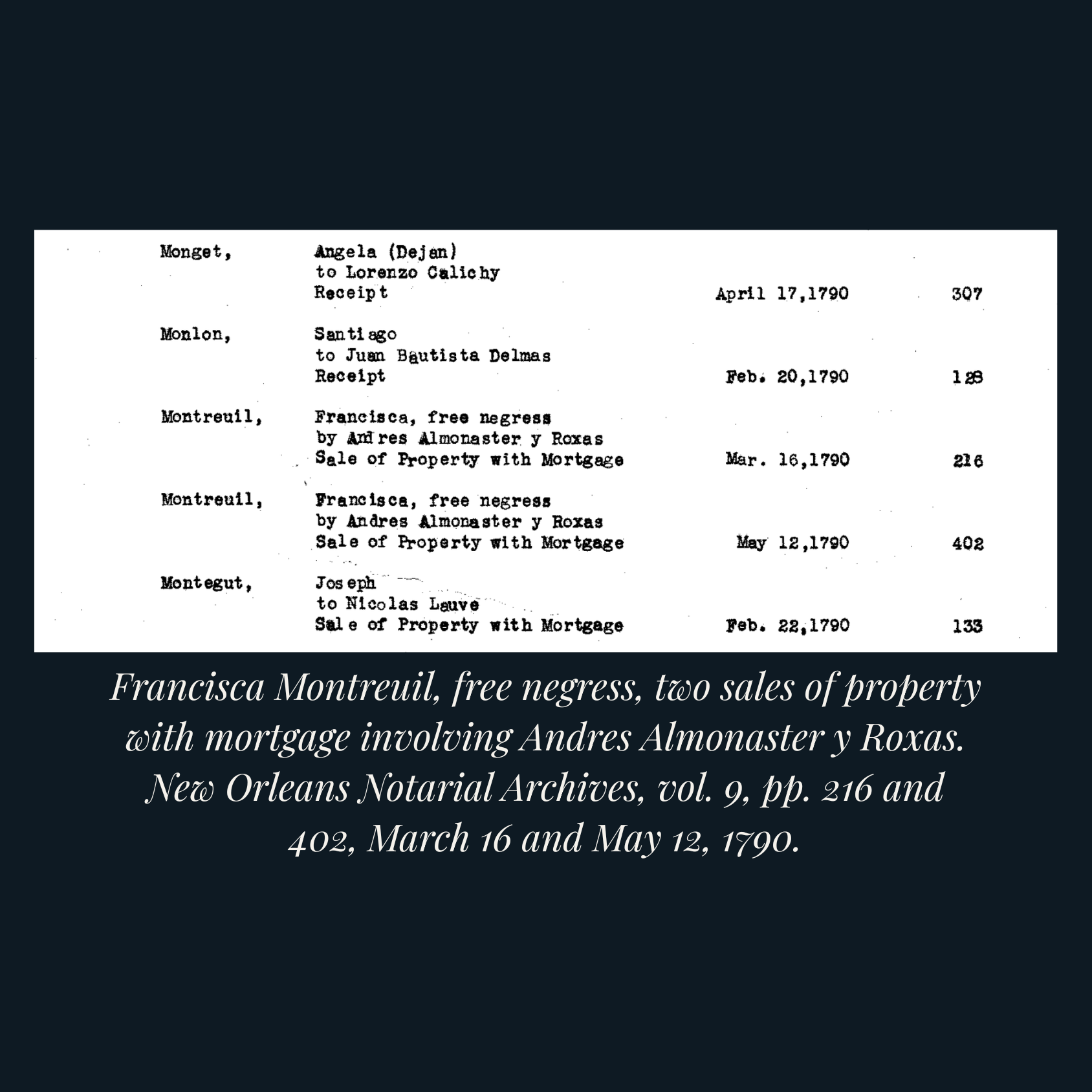
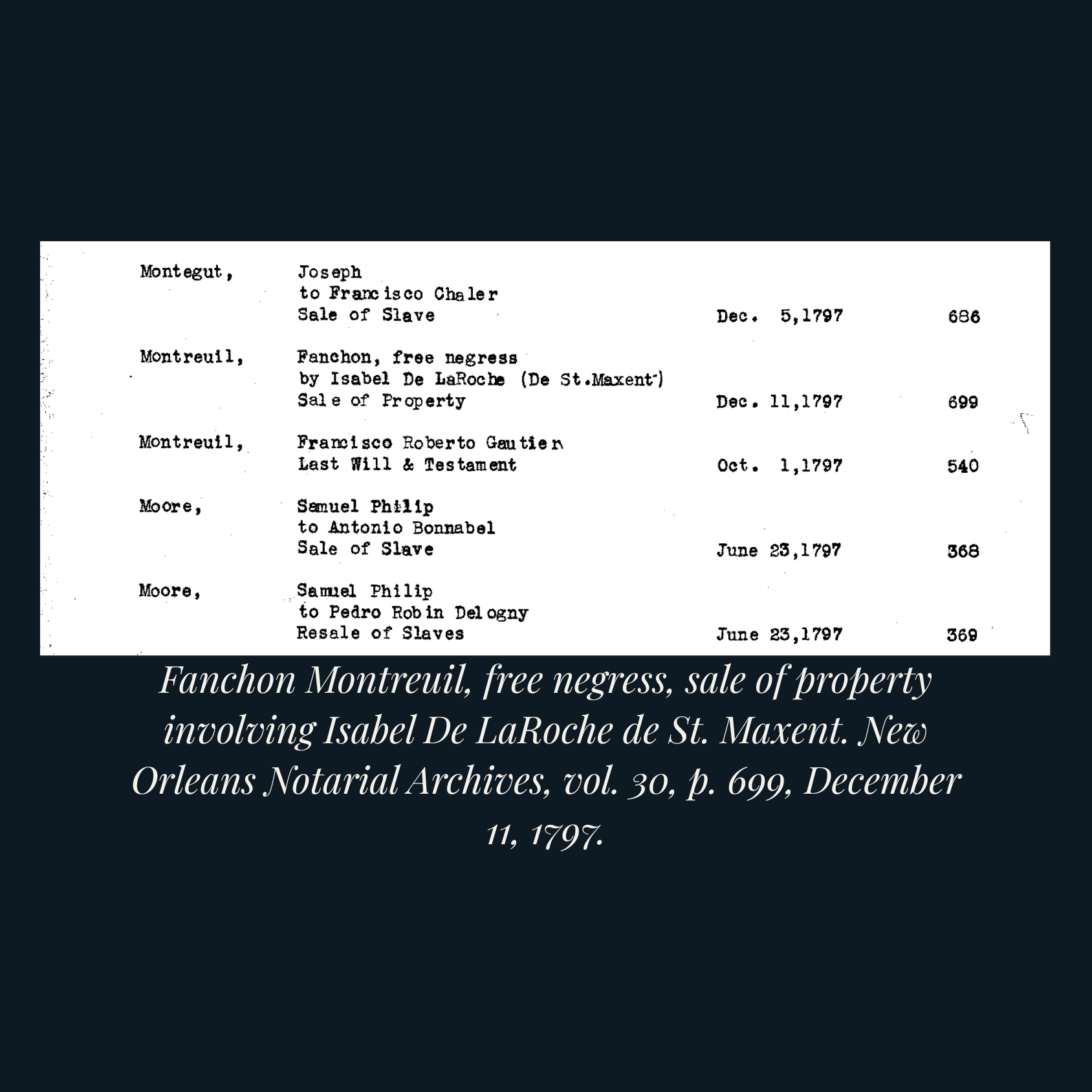
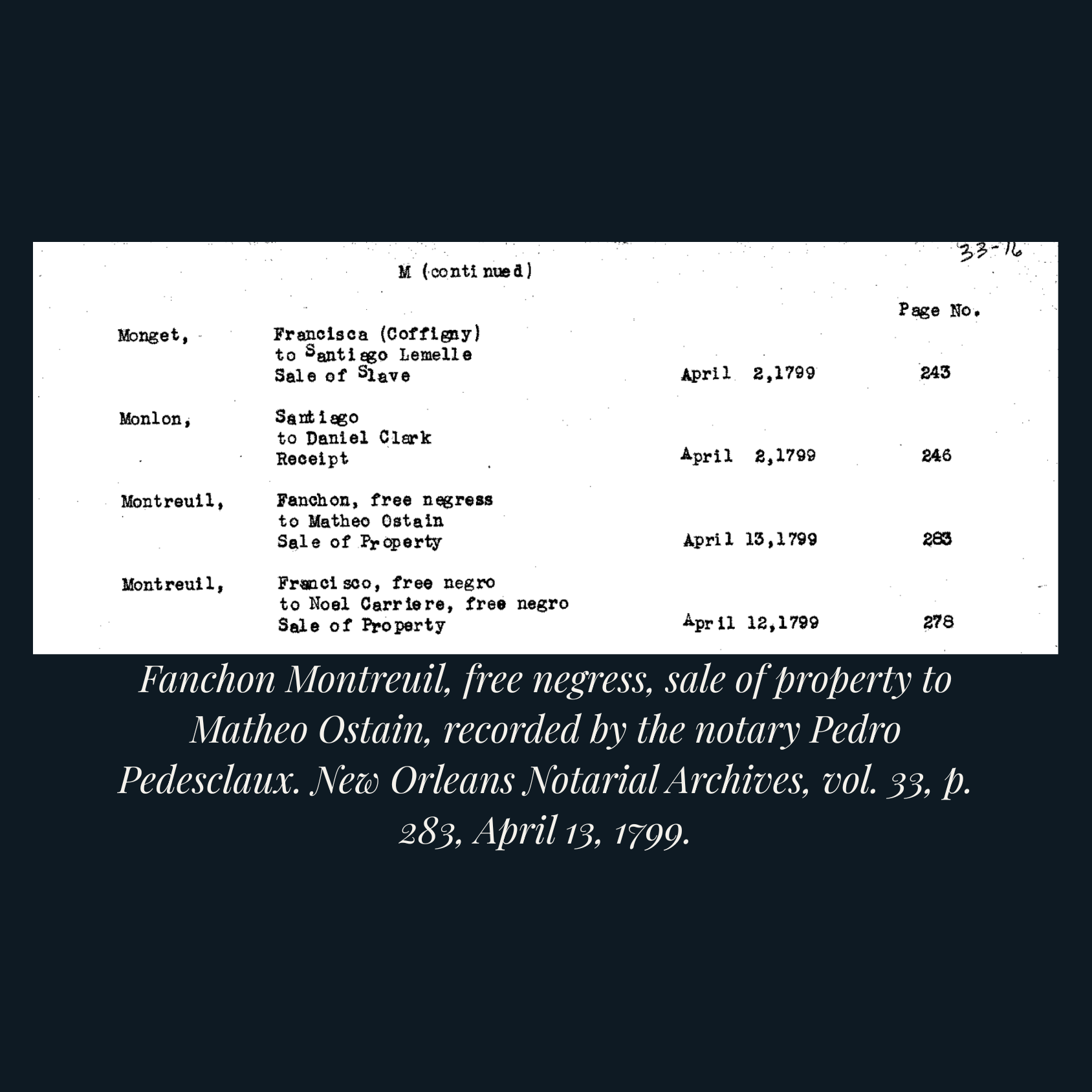
The record that follows her own emancipation reads like the record of a woman managing a portfolio rather than a woman surviving from one year to the next. Under the names Francisca and Fanchon Montreuil she surfaces in the New Orleans notarial record again and again from 1790 through 1802, recorded in every entry plainly as a free negress, with the acts spread across volume after volume of the notarial books. She sold property with mortgage to Andres Almonaster y Roxas, the colony’s great property holder and benefactor, in the spring of 1790, and she transacted with a member of the prominent St. Maxent family in 1797, and she carried on buying and selling all the way to a property sale recorded in 1802. She bought, and she sold, and she returned to buy again, in a rhythm that belongs to someone managing assets rather than someone merely holding on, and she did it on terms with the most established names in the city.
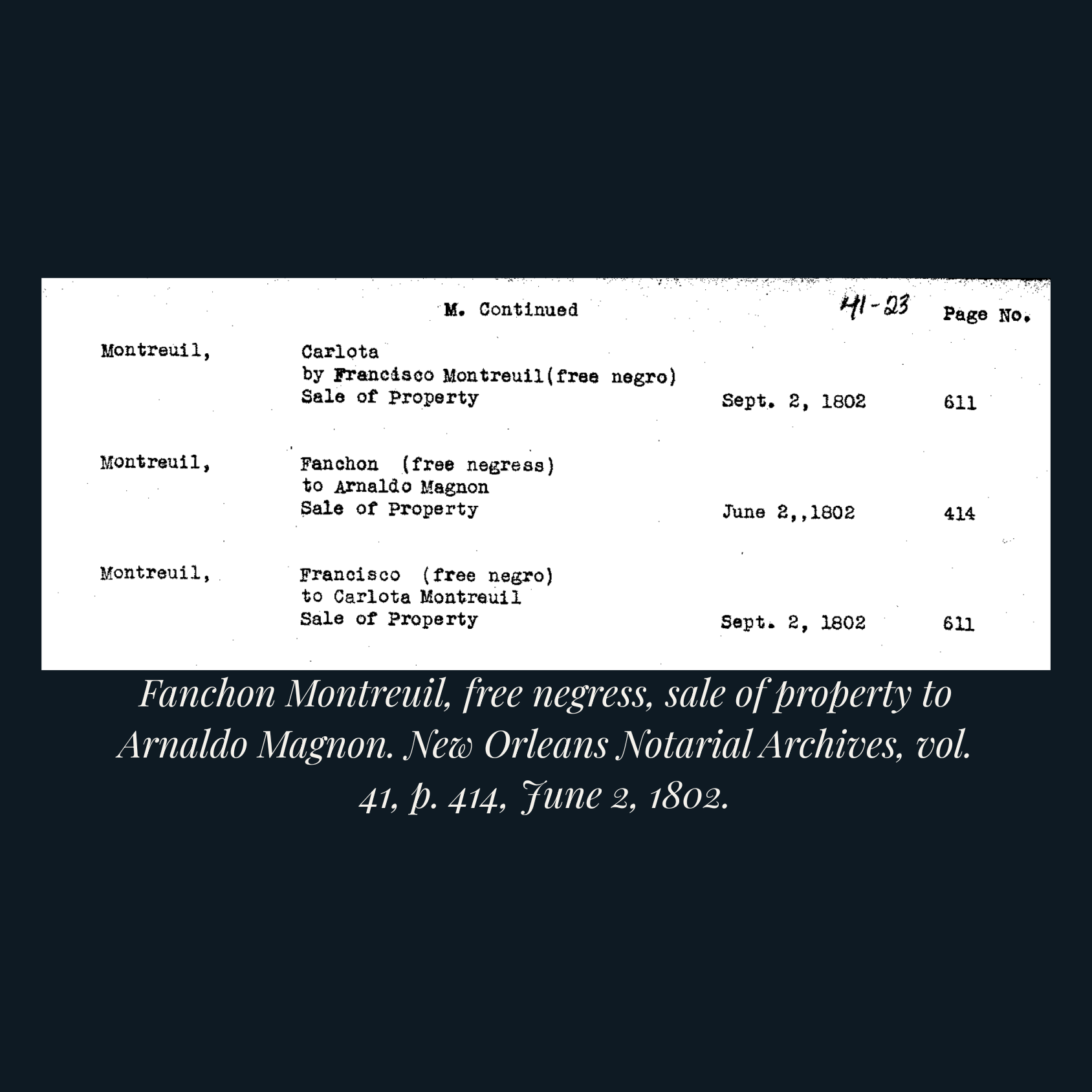
When Francisca died in 1803, the inventory taken of her estate placed its gross value at 10,459 pesos, and after debts of 3,157 pesos and 3 reales were settled, the remaining 7,301 pesos and 5 reales passed to her children and grandchildren. The scholarly reconstruction of the estate describes two plantations along Bayou Road, while the public sale notice printed at her death describes the real property differently, naming a dwelling on the road to Bayou St. Jean near the bridge and a house on Bourbon Street in the heart of the city. The record carries both descriptions, and the difference between them is left standing here rather than resolved, because the surviving documents do not settle which framing is exact.
Freedom in this period was never a status anyone was simply granted, it was an asset that had to be purchased outright, defended in writing, and moved carefully before the rules could change underneath you.
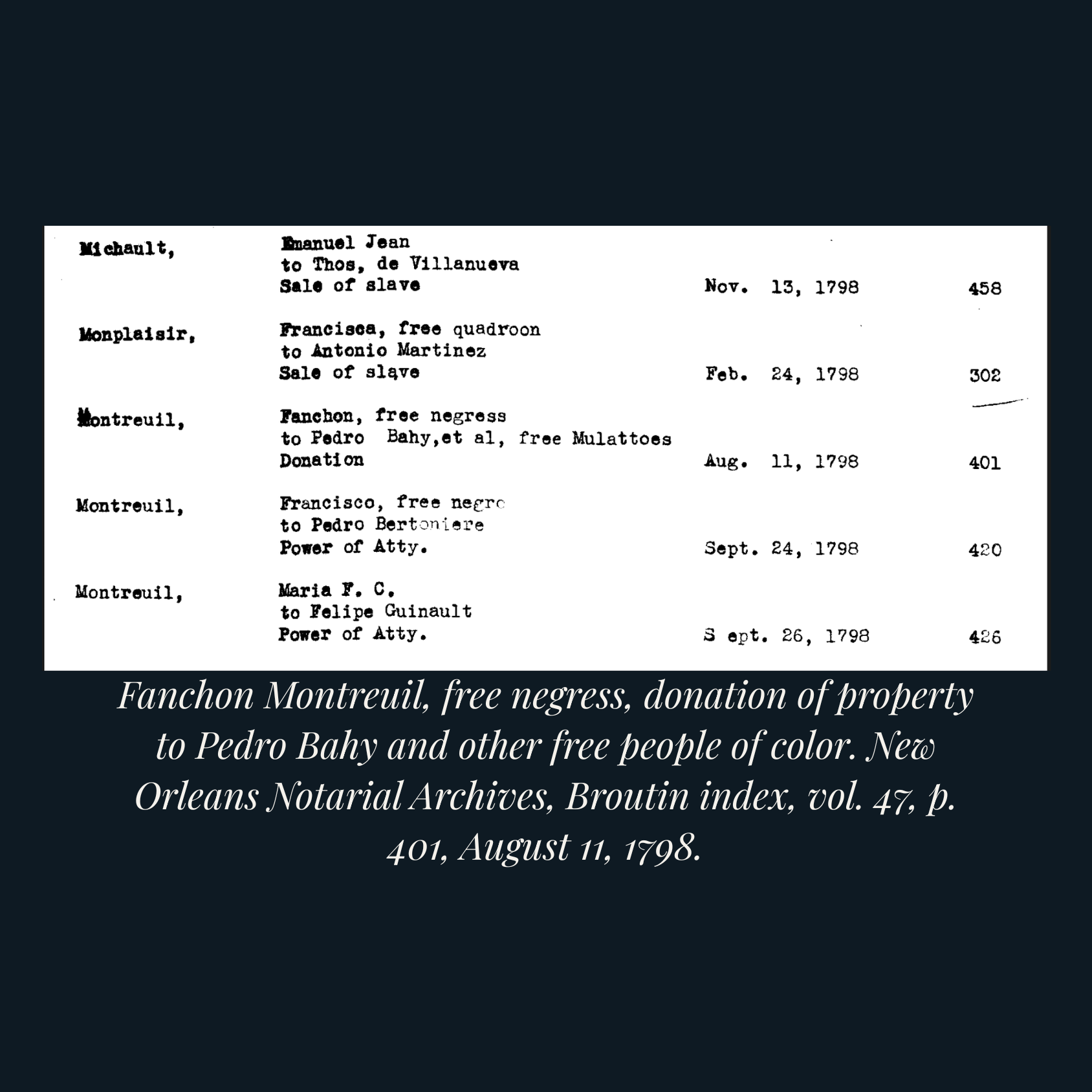
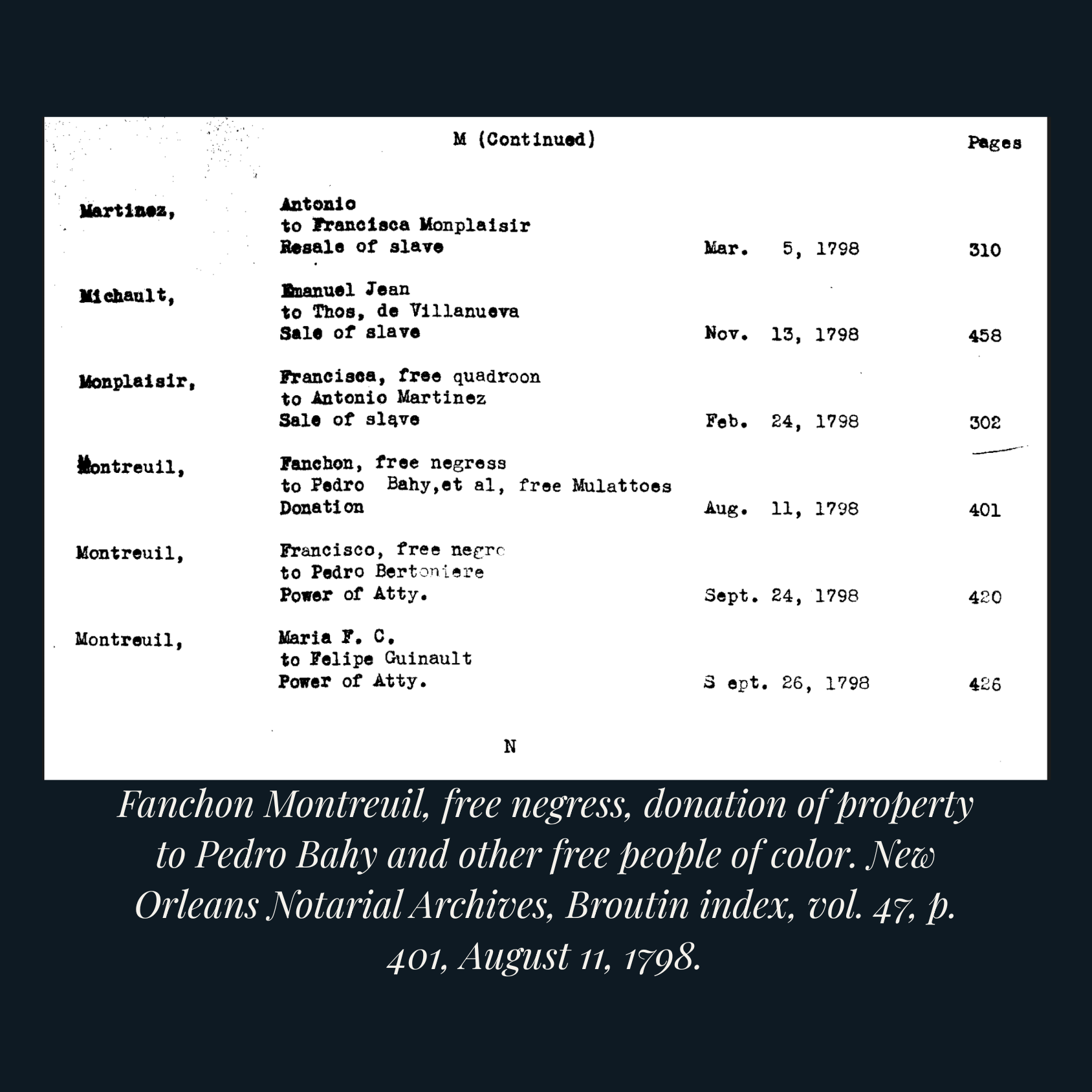
She had also moved a great deal of that wealth while she was still living rather than waiting on her death to do it, with donations of one thousand pesos to each of two grandsons and dowries of three hundred ninety pesos to Naneta and four hundred fifty pesos to her daughter Maria Genoveva. The notarial record preserves the pattern in her own hand, including a donation of property she made in 1798 to Pedro Bahy and other free people of color. That is the deliberate transfer of capital through a community and a family, arranged in advance and committed to writing.
The Truth the Record Holds
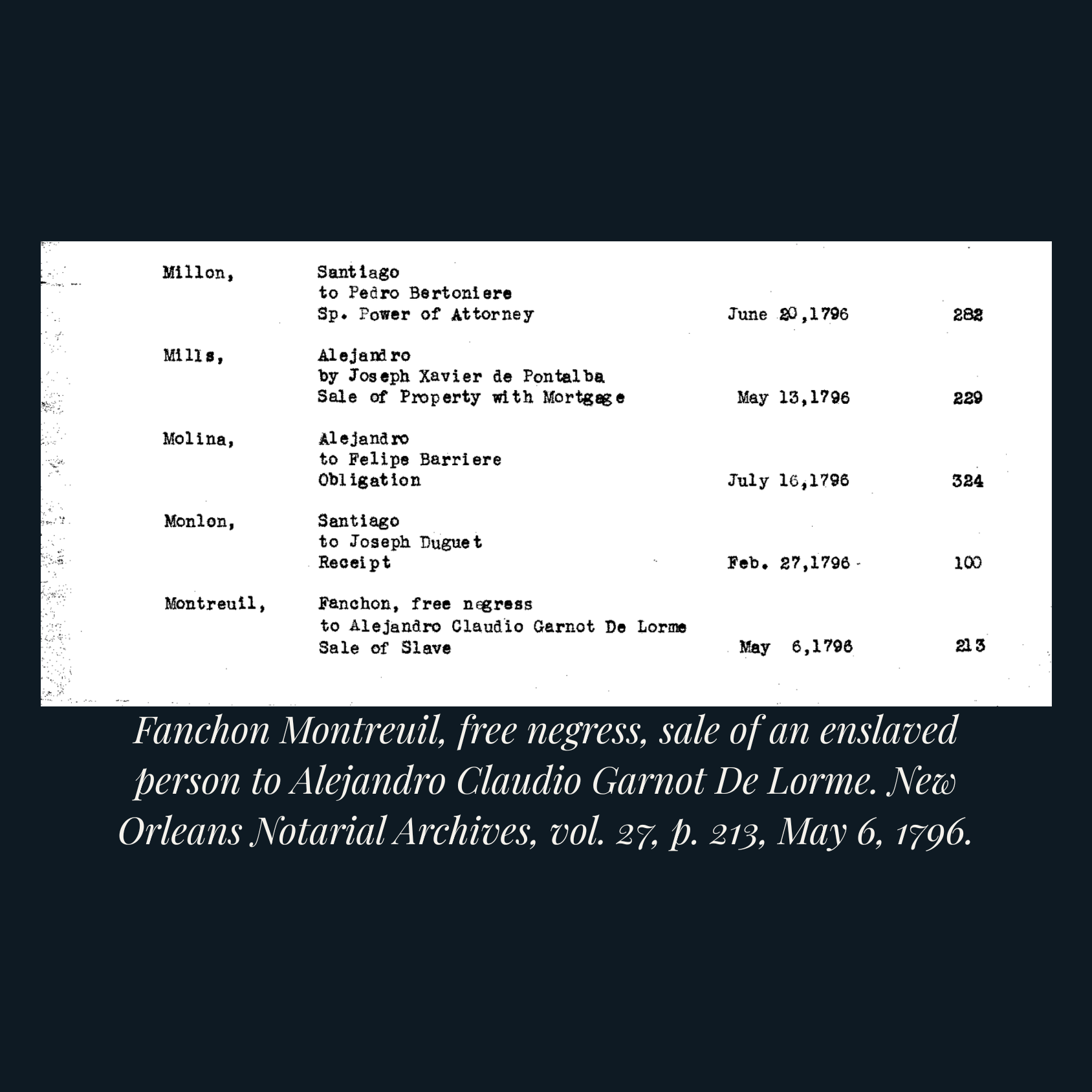
Her file also holds a truth that honest history does not get the privilege of editing out. Some free people of color, and Francisca was among them, owned enslaved people themselves. The notarial record shows her selling an enslaved person to Alejandro Claudio Garnot De Lorme in the spring of 1796, a completed act of sale in her own name, and her estate makes the fact explicit again at her death, with five enslaved people appraised at 2,650 pesos and listed among the assets her heirs received and one additional person promised freedom.
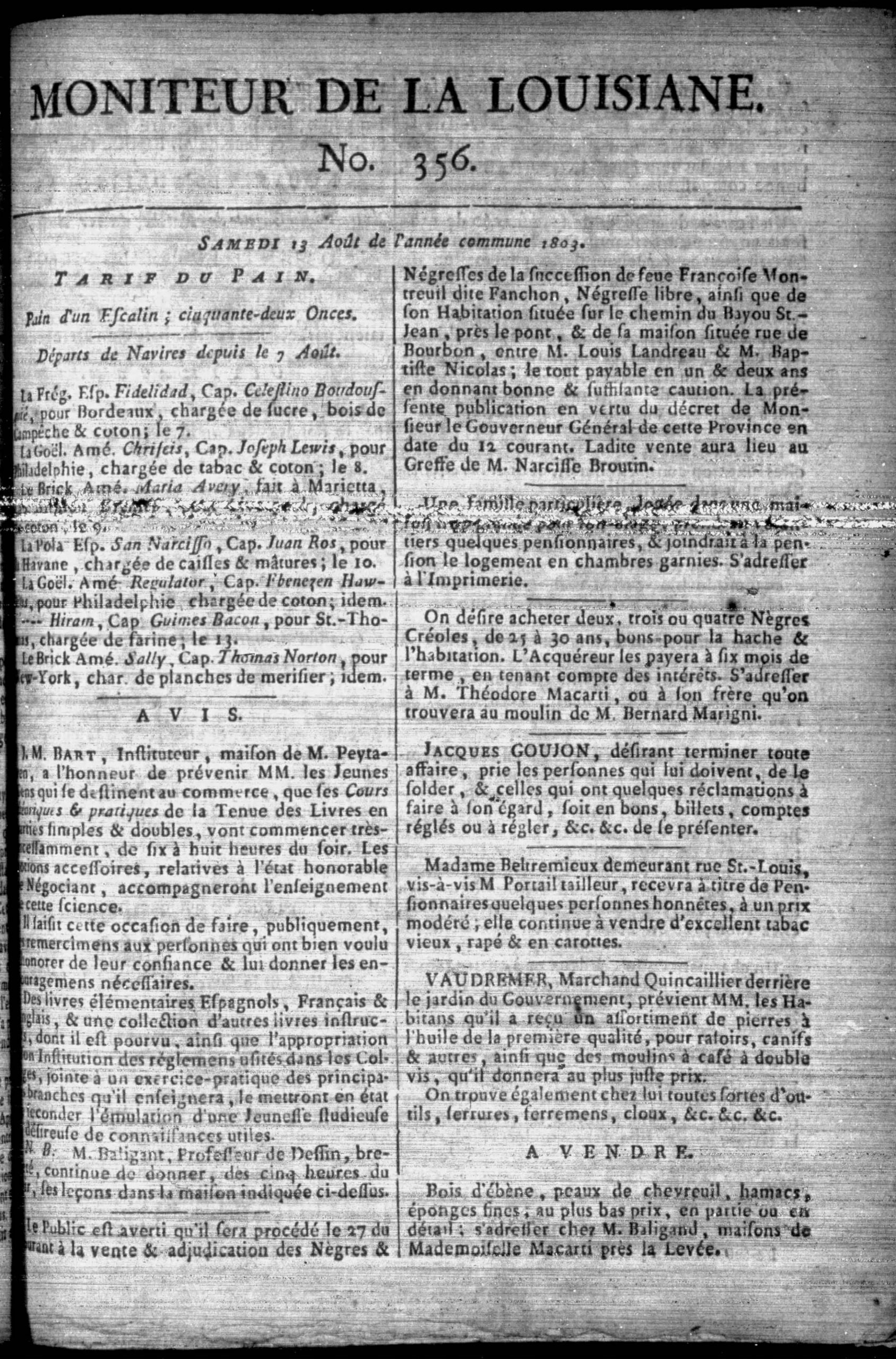
The hardest evidence comes at the very end. When her succession was settled, the enslaved women she had held were not all passed quietly to her heirs. In August of 1803, the Moniteur de la Louisiane carried a public notice advertising the sale and adjudication of enslaved women from the succession of the late Françoise Montreuil, called Fanchon, free Negress, together with her real property, the sale to be held at the registry office of the notary Narcisse Broutin. The people she had owned were liquidated as assets to settle her estate, advertised in the newspaper by the name of her succession. The record does not soften that, and the telling of it will not either.
After 1803
The timing of her ending arrives almost too neatly to believe. Her estate was divided in 1803, the same year the Louisiana Purchase handed New Orleans over to the United States, and the very latitude that had allowed her to accumulate and transfer this kind of wealth was a feature of the Spanish legal order, with its long tradition of self purchase and its relatively open notarial system for free people of color. American rule began closing that window almost immediately, and over the decades that followed the legal space for free people of color narrowed steadily until, by the late antebellum period, it had hardened into something nearly unrecognizable.
Francisca Montreuil is foundational rather than famous because hers is one of the few cases in which the entire sequence survives inside a single file. One life can never prove that a pattern existed across a whole class of people, but what it can do is make that pattern visible rather than merely inferred, and in her record you can watch it happen in order, as a Black woman bought herself and her children out of slavery, used the colonial legal system to her own advantage, converted skilled trade work into capital, concentrated property in Afro Creole hands, and assembled a fortune she then handed down on purpose.
She was never famous, but she was foundational, and we are calling her by name.
Who ya’ people? ⚜️
Bibliography
Hanger, Kimberly S. Bounded Lives, Bounded Places: Free Black Society in Colonial New Orleans, 1769–1803. Durham: Duke University Press, 1997.
Johnson, Jessica Marie. Wicked Flesh: Black Women, Intimacy, and Freedom in the Atlantic World. Philadelphia: University of Pennsylvania Press, 2020.
“Free People of Color.” 64 Parishes. Louisiana Endowment for the Humanities. https://64parishes.org/entry/free-people-of-color.
Moniteur de la Louisiane (New Orleans). “Vente de la succession de Françoise Montreuil dite Fanchon.” No. 356, August 13, 1803.
New Orleans Notarial Archives. Acts of the notary Broutin (no. 3, fol. 108, April 8, 1801; no. 5, fol. 192, April 23, 1803). Index to notarial acts recording the transactions of Francisca, also Fanchon, Montreuil, free negress, in New Orleans from 1790 to 1802, including property sales with Andres Almonaster y Roxas (vol. 9, pp. 216 and 402, 1790), Isabel De LaRoche de St. Maxent (vol. 30, p. 699, 1797), Matheo Ostain (vol. 33, p. 283, 1799, recorded by Pedro Pedesclaux), and Arnaldo Magnon (vol. 41, p. 414, 1802), a lifetime donation of property to Pedro Bahy and other free people of color (Broutin index, vol. 47, p. 401, 1798), and sales of enslaved people (vol. 27, p. 213, 1796; vol. 21, p. 933, 1794, annulled). New Orleans, Louisiana.