This day in history · May 22, 1909
Who the USDA Helped: Three Crop Notices from One 1909 Louisiana Newspaper
The boll weevil crossed every parish in Louisiana. The Department of Agriculture did not.
By The Kinstructure Company · May 22, 2026 · 9 min read
On May 22, 1909, the St. Landry Clarion ran three short notices on the same Saturday morning. One came from the Lafayette Advertiser. One came from the Avoyelles Enterprise. One reported on a prominent planter in East Baton Rouge Parish. Three pieces. Three parishes. Three pictures of the same crisis from three different positions inside it.
When the weevil came, the ledger stopped balancing.
Read those three pieces in sequence and the documentary record tells a harder story than the one the standard Great Migration histories usually tell.
Lafayette: The Pest Arrives
The first notice was brief. Reports from various parts of Lafayette Parish indicated that considerable damage was being done to the cotton crops by insects the farmers generally took to be boll weevils. In consequence, many farmers had replaced their cotton with corn, having concluded they would not be able to make a cotton crop that season.
The boll weevil had crossed into Louisiana from Texas around 1903. By 1909 it had reached Lafayette and St. Landry. By 1915 it had moved through every cotton-growing parish in the state. Cotton was the cash economy of south Louisiana. It was how tenant farmers settled accounts at the end of the year. It was how landowners paid their notes. It was how Black farmers, Creole farmers, and small white farmers all kept the ledger straight with the merchant and the bank.
When the weevil came, the ledger stopped balancing.
Avoyelles: Diversification Without the Knowledge
The second notice ran longer. The St. Landry Clarion reprinted a piece from the Avoyelles Enterprise reporting that the Irish potato crop in Avoyelles Parish had not turned out as well as expected. The piece read like a tired extension agent at the end of a long season. The farmers, the Enterprise observed, had not given proper attention to the quality and kind of seed they had planted. The kind of fertilizer to be applied and the quantity to be used had not received sufficient consideration. The Enterprise concluded that to obtain successful results, the farmer must buy seed potatoes known to yield abundantly, must analyze the quality of his land, and must ascertain what kind of fertilizer to use and how much of it.
What the Enterprise was describing, in the plain language of an early twentieth century agricultural column, was the absence of the entire knowledge base that successful diversification required. The seed expertise was not there. The soil science was not there. The fertilizer expertise was not there. The Avoyelles farmers were trying to diversify out of cotton because the cotton was failing, and the diversification was failing too, because the support system that would have made it work had not reached them.
East Baton Rouge: Diversification With the Knowledge
The third notice told the other half of the story. James Clayton, identified by the Clarion as a prominent planter in East Baton Rouge Parish, was demonstrating what successful diversification looked like. From a forty-acre tract he had taken out of cotton, Clayton was cutting two tons of oats per acre at twelve dollars a ton. From the same ground, he would harvest two tons of lespedeza hay at the same price. The piece reported a clear forty-eight dollars per acre on a five dollar per acre input. Cotton, under favorable conditions, might bring sixty dollars per acre, but it would cost thirty dollars to plant, cultivate, pick, and bring to market. Clayton’s calculation showed a clear profit of ten dollars more per acre on oats and hay than on cotton.
The piece opened with a line worth reading twice. “What the Department of Agriculture has been setting before the farmers of Louisiana since the advent of the boll weevil, that there are other moneyed crops for the cotton growing sections of Louisiana besides cotton, has been demonstrated in East Baton Rouge by James Clayton, one of the prominent planters in that parish.”The Department of Agriculture had been at James Clayton’s door.
The Department of Agriculture had been at James Clayton’s door.
What the Three Pieces Document Together
Read in sequence, the three notices document the structural inequality of the federal agricultural response to the boll weevil. The pest was real. The pest crossed every parish in Louisiana between 1903 and 1915. The pest did not, on its own, decide who would survive the transition out of cotton and who would not. The federal agricultural extension system made that decision, parish by parish, planter by planter, and the people who received the USDA’s instruction were not the same people who were tenant farming Lafayette Parish or trying to plant Irish potatoes in Avoyelles without the science behind them.
The pest crossed every parish in Louisiana between 1903 and 1915. The pest did not, on its own, decide who would survive.
James C. Giesen, whose 2011 study of the boll weevil response in the American South remains the definitive treatment of the subject, has documented at length how the federal extension system in the early twentieth century was structured to reach commercial planters first, and how Black farmers, tenant farmers, and small landowners were systematically underserved by the agricultural demonstration work that helped large operators transition successfully out of cotton. The economic historians Fabian Lange, Alan L. Olmstead, and Paul W. Rhode have shown that the boll weevil’s economic impact varied enormously by who farmed the land and how, with the heaviest losses falling on the populations who had the least capacity to absorb them. James N. Gregory’s work on the Southern Diaspora has demonstrated that the population movements out of the South in the first half of the twentieth century were not random, and that the same structural inequalities that determined who survived agricultural transitions also determined who had to leave.
What the May 22, 1909, edition of the St. Landry Clarion documents is one Saturday morning in one Louisiana newspaper where the inequality is printed out on a single page. Lafayette farmers losing their cotton. Avoyelles farmers losing their experiment. East Baton Rouge’s prominent planter cashing in on the USDA’s recommendation. All on the same page. All on the same date. All inside the same agricultural crisis.
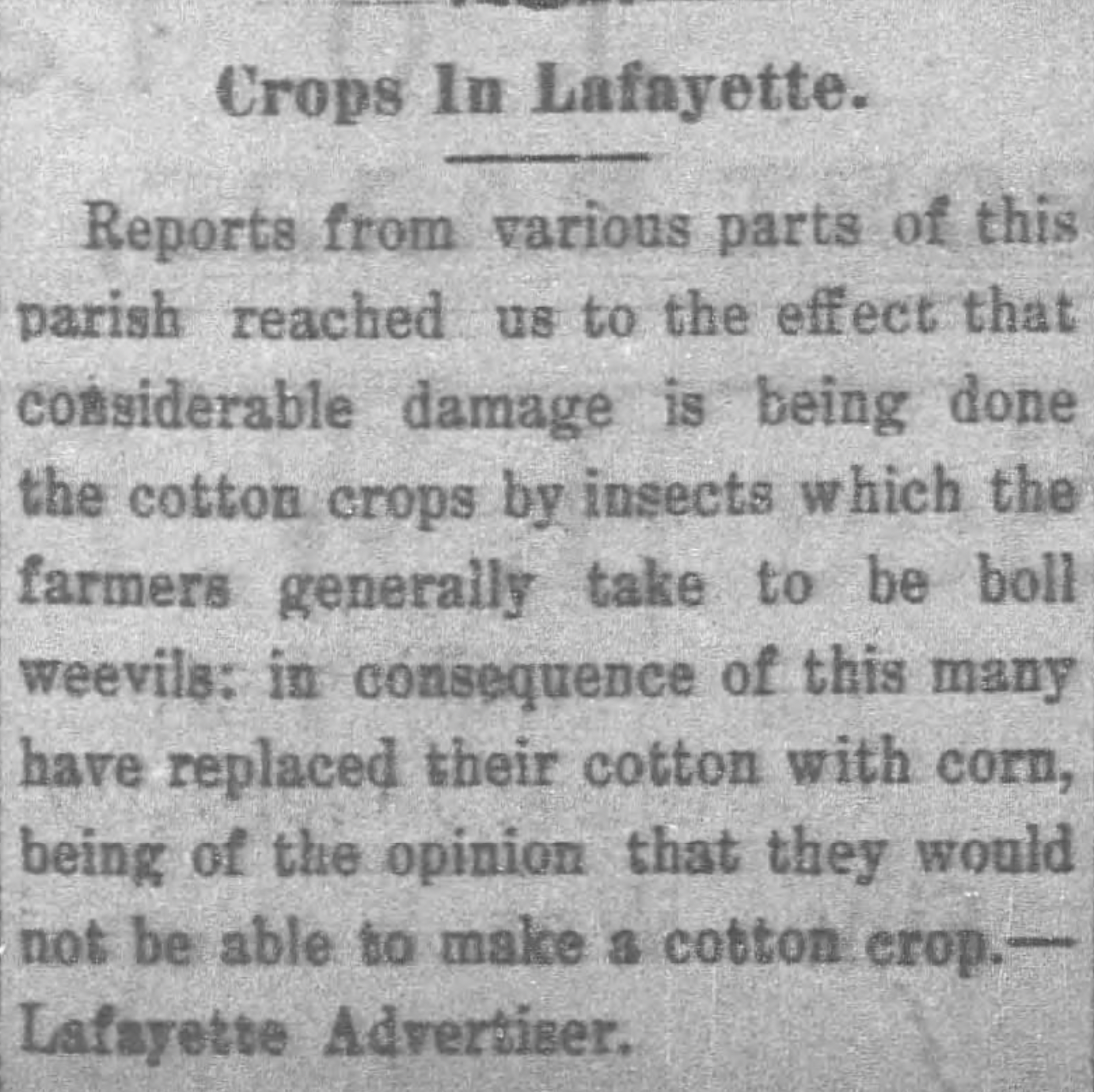
“Crops In Lafayette,” reprinted from the Lafayette Advertiser. St. Landry Clarion (Opelousas, La.), May 22, 1909, p. 9. 
“Farmers Disappointed: The Irish Potatoe Crop of Neighboring Parish Did Not Turn out As Well As Expected,” reprinted from the Avoyelles Enterprise. St. Landry Clarion (Opelousas, La.), May 22, 1909. 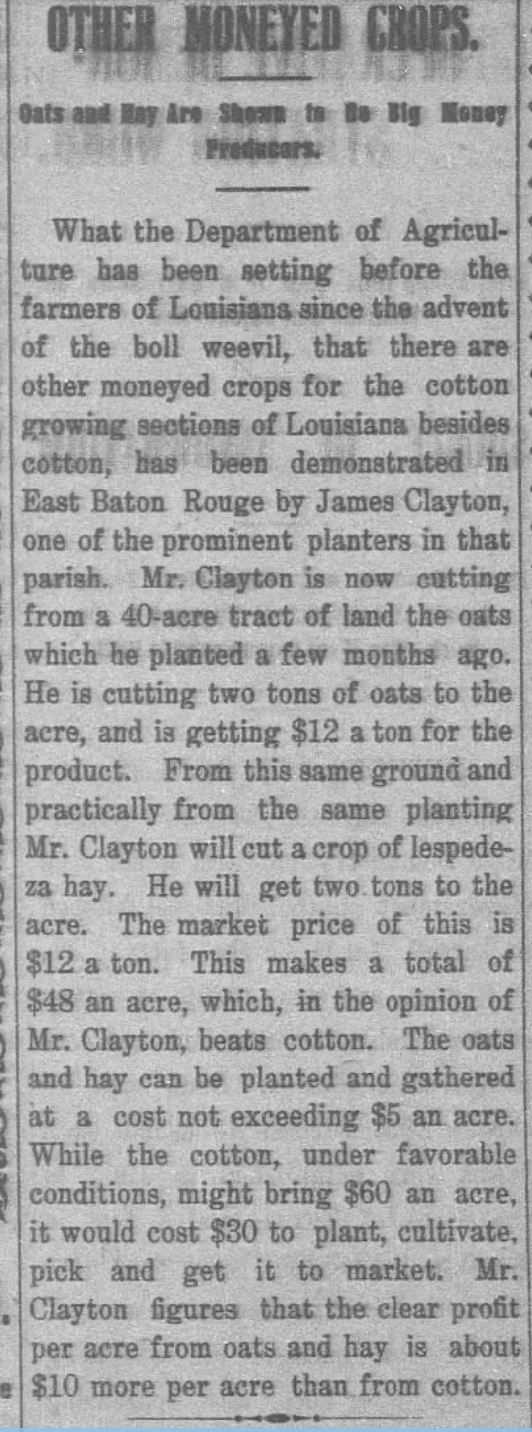
“Other Moneyed Crops. Oats and Hay Are Shown to Be Big Money Producers.” St. Landry Clarion (Opelousas, La.), May 22, 1909.
The People Who Could Not Get to the Other Side
The people who could not get to the other side of the transition had to go somewhere.
Some moved into Louisiana towns and took work in lumber, rice, sugar, and the early oil fields. Some crossed into Texas, following the rail lines into Beaumont, Port Arthur, and Houston, where refineries and shipyards were hiring. Some went further. Louisiana families turned up in Los Angeles, Oakland, Chicago, and Detroit in the decades that followed, often arriving in neighborhoods where their cousins and church people from back home had already settled.
This is the Louisiana side of the Great Migration. It is not the only reason families left. Jim Crow violence, lynching, sharecropping debt, the 1927 flood, and the collapse of the timber economy all pushed people out of the state. The structural inequality of the federal agricultural response to the boll weevil is one thread in that larger story, and the May 22 edition of the Clarion is one of the cleanest places you can watch the inequality printed out in real time.
The families that left Louisiana did not stop being Louisiana. They carried the language, the food, the saints, the second lines, the Mardi Gras Indians, the zydeco, the file gumbo, and the names of the parishes they came from into every city they reached. Three and four generations later, their descendants are in California and Texas and Illinois and Michigan, still calling themselves Creole, still saying their grandmother was from Opelousas or Lafayette or Marksville or Plaquemine, still asking each other who their people are.
The weevil came for the cotton. The USDA came for some of the farmers. The rest of them carried the parish with them when they left.
The weevil came for the cotton. The USDA came for some of the farmers. The rest of them carried the parish with them when they left.
That is why the diaspora exists.
Who ya’ people? ⚜️
Bibliography
“Crops In Lafayette.” Reprinted from the Lafayette Advertiser. St. Landry Clarion (Opelousas, La.), May 22, 1909, p. 9. Digital image. Newspapers.com. https://www.newspapers.com/image/174373055/.
“Farmers Disappointed: The Irish Potatoe Crop of Neighboring Parish Did Not Turn out As Well As Expected.” Reprinted from the Avoyelles Enterprise. St. Landry Clarion (Opelousas, La.), May 22, 1909. Digital image. Newspapers.com.
Giesen, James C. Boll Weevil Blues: Cotton, Myth, and Power in the American South. Chicago: University of Chicago Press, 2011.
Gregory, James N. The Southern Diaspora: How the Great Migrations of Black and White Southerners Transformed America. Chapel Hill: University of North Carolina Press, 2005.
Lange, Fabian, Alan L. Olmstead, and Paul W. Rhode. “The Impact of the Boll Weevil, 1892 to 1932.” Journal of Economic History 69, no. 3 (September 2009): 685 to 718.
“Other Moneyed Crops. Oats and Hay Are Shown to Be Big Money Producers.” St. Landry Clarion (Opelousas, La.), May 22, 1909. Digital image. Newspapers.com.