This day in history · June 26, 1850
Ten Dollars and Two Hundred
A Reward Differential in 1850 New Orleans
By The Kinstructure Company · june 26, 2026 · 4 min read
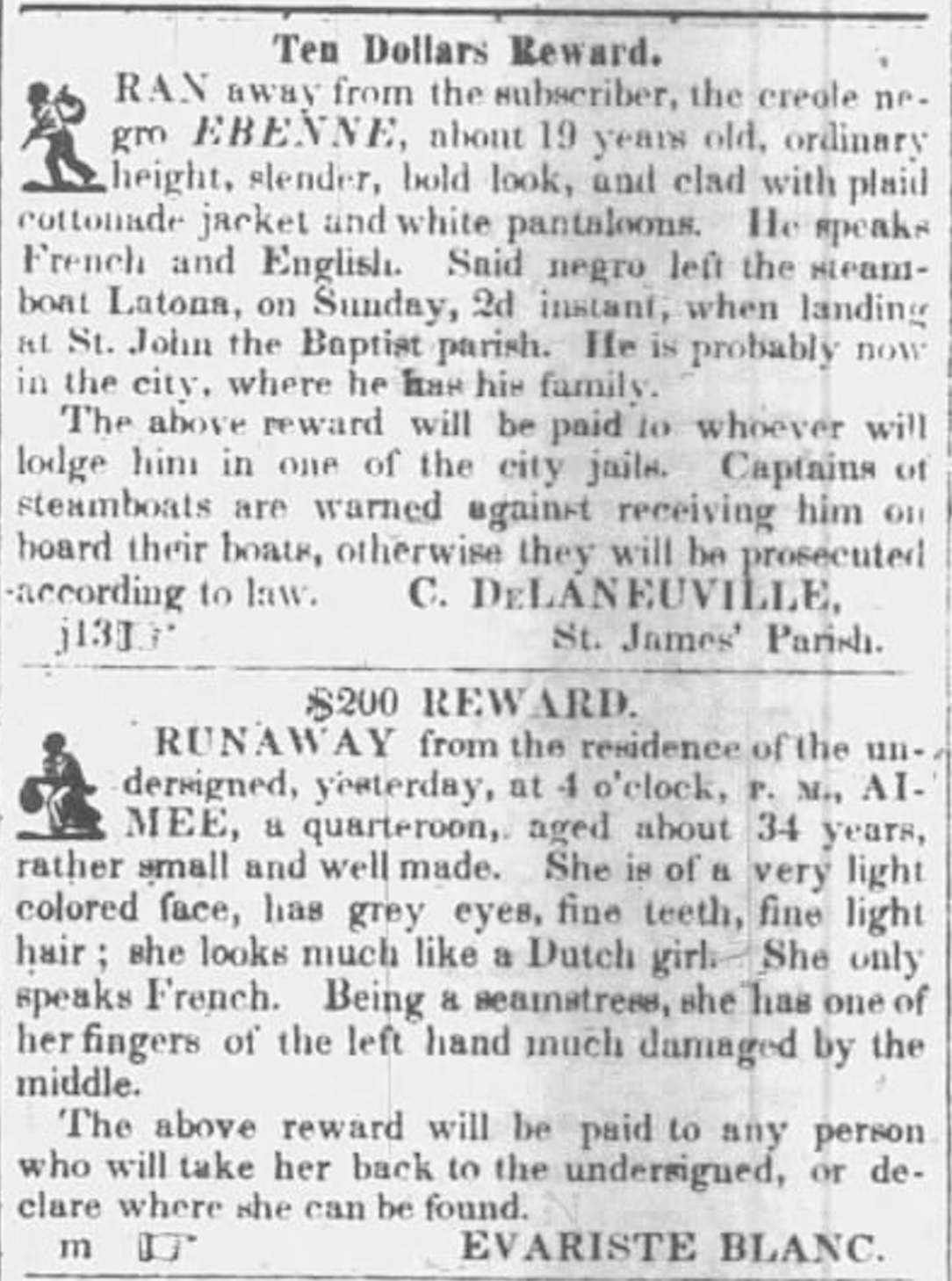
Two Notices, One Page
On June 26, 1850, page three of The Courier in New Orleans carried two advertisements for people who had freed themselves from slavery. They sat near one another in the same column, and read together they reveal something the men who placed them never intended to confess. The difference between them is a number, and the number is the argument..
Ebenne
The first notice offered ten dollars. It described Ebenne, about nineteen years old, of ordinary height, slender, with a bold look, clad in a plaid cottonade jacket and white pantaloons, and able to speak both French and English. He had left the steamboat Latona on Sunday the second, landing at St. John the Baptist parish, and the notice judged him probably now in the city, where it admits he had his family. C. Delaneuville of St. James Parish asked that he be lodged in one of the city jails and warned steamboat captains against receiving him aboard their boats under threat of prosecution. The notice had first run on June 13, so it had been standing for roughly two weeks.
Even in a document meant to retrieve him as property, Ebenne’s reach is legible. He went where his family was. The notice’s own logic, that he was probably in the city because his people were there, records a man moving toward the human ties slavery was built to sever.
Aimée
The second notice offered two hundred dollars. Twenty times as much. It described Aimée, aged about thirty-four, rather small and well made, a seamstress who spoke only French. The notice dwells on her appearance, and it does so for a reason. She had a very light colored face, grey eyes, fine teeth, and fine light hair. In the words of the man who claimed her, she looked much like a Dutch girl. The notice also records that one finger of her left hand was much damaged near the middle. Evariste Blanc asked that she be brought back or that her whereabouts be declared, and he had set this price within a day of her leaving his residence at four in the afternoon.
The gap between ten dollars and two hundred is the document pricing the failure of its own logic.
Blanc paid twenty times Delaneuville’s reward, and the catalog of Aimée’s features explains why. Everything the notice records so carefully, the light face, the grey eyes, the fine hair, the resemblance to a Dutch girl, describes a woman who could move through New Orleans as white. The very traits set down to identify her were the traits that made her nearly impossible to catch. A general description of a light-skinned woman who spoke French would have fit a free citizen on any street in the city.
The Confession in the Price
That is why the damaged finger appears in the notice at all. Aimée’s face would not betray her, and her speech would not, and her bearing would not. So the notice reached past all of it for the one mark that might, a single injured finger on her left hand. The slaveholder pricing her near-whiteness at two hundred dollars was, in the act of writing, admitting what that price meant. The color line he depended on, the line the entire legal and economic order of the city was built to enforce, was a line a thirty-four-year-old seamstress could cross by walking out a door.
Read together, the two notices expose the lie at the center of the system. If race were the fixed and visible thing the law claimed, ten dollars and two hundred would not sit on the same page. The differential is the slaveholders themselves admitting that the boundary between enslaved and free, between Black and white, was porous enough to demand a fortune to defend in a single case. Aimée’s body was priced not for her labor but for the threat her appearance posed to the fiction.
Their names were printed in The Courier so that strangers could seize them and return them to bondage. We print them here for the opposite purpose. Ebenne went toward his family. Aimée walked into a city that could not easily see her as what the law insisted she was. They were people, and they reached for their freedom, and the price set on their recapture is the clearest confession the record offers of how fragile their captors knew that system to be.
Who ya’ people? ⚜️
Bibliography
“$200 Reward.” Advertisement, Evariste Blanc. The Courier (New Orleans, La.), June 26, 1850, p. 3. Digital image. Newspapers.com.
“Ten Dollars Reward.” Advertisement, C. Delaneuville. The Courier (New Orleans, La.), June 26, 1850, p. 3. Digital image. Newspapers.com.