this day in history · May 15, 1862
General Order No. 28 and the Women of Occupied New Orleans, May 15, 1862
The federal commander of occupied New Orleans tried to discipline the women of the city by reclassifying them in print. The order detonated.
By The Kinstructure Company · May 15, 2026 · 8 min read
On May 15, 1862, two weeks into the federal occupation of New Orleans, Major General Benjamin F. Butler issued General Order No. 28 from the headquarters of the Department of the Gulf. Eight sentences of letterpress. Fewer than two hundred words. Directed at one problem, the occupying army could not solve. The women of New Orleans were insulting Union soldiers in the streets, and Butler could not stop them.
The Setting
New Orleans fell on April 25, 1862, when Flag Officer David Farragut’s flotilla ran past the Confederate defenses at Forts Jackson and St. Philip. Butler disembarked as military governor on the evening of May 1 and began an occupation that would last seven and a half months and produce some of the most contested military governance of the Civil War.
The city Butler entered was the largest in the Confederacy, the principal port of the Mississippi River system, and the most demographically complex urban environment in the slaveholding South. The mayor, John T. Monroe, refused to cooperate and was arrested. The civil administration was placed under martial law. Episcopal churches were closed for refusing to pray for President Lincoln. William B. Mumford, a private citizen, was tried and hanged for tearing down a United States flag that Admiral Farragut had placed over the New Orleans Mint.
The Civilian Resistance
Against this backdrop, civilian women in occupied New Orleans conducted what would now be classified as nonviolent symbolic resistance. They turned their backs on Union officers in the streets. They crossed to the opposite sidewalk when troops approached. They left streetcars when soldiers boarded, displaying what one contemporary witness described as every sign of disgust, abhorrence, and aversion. They sang Confederate songs in their presence. They held their skirts aside as if contact with the uniform would contaminate the fabric. The most documented incident, the proximate trigger for Butler’s order, was a quantity of dirty water poured from a window directly onto Admiral Farragut as he walked through the French Quarter.
This was coordinated political behavior conducted by women who understood that their gender insulated them from the consequences of physical resistance. A man who tore down a federal flag would be hanged, as Mumford was. A woman who spat on a Union officer could not be hanged, could not be jailed for long without political cost, and could not be physically retaliated against without producing exactly the propaganda outcome the women hoped to provoke. The strategy depended entirely on the operating assumption that ladies were untouchable.
The strategy depended entirely on the operating assumption that ladies were untouchable.
The Order Itself
The full text reads as follows:
As the officers and soldiers of the United States have been subject to repeated insults from the women, calling themselves ladies, of New Orleans, in return for the most scrupulous non-interference and courtesy on our part, it is ordered that hereafter when any female shall by word, gesture, or movement insult or show contempt for any officer or soldier of the United States she shall be regarded and held liable to be treated as a woman of the town plying her avocation.
Source: General Order No. 28, Headquarters Department of the Gulf, New Orleans, May 15, 1862. Library of Congress.
she shall be regarded and held liable to be treated as a woman of the town plying her avocation.
The phrase carried a specific nineteenth century meaning. A woman of the town plying her avocation was a prostitute. Butler had not authorized assault. He had authorized the withdrawal of social protection. He had instructed Union troops to stop treating elite white Confederate women as ladies when those women acted otherwise. The threshold for that forfeiture was extraordinarily low. Word, gesture, or movement. Not assault. Not vandalism. The order criminalized posture.
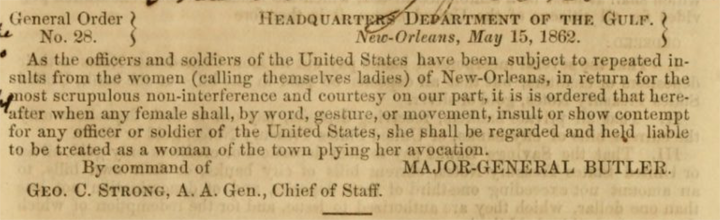
General Order No. 28. Headquarters Department of the Gulf, New Orleans, May 15, 1862. By command of Major General Butler. Geo. C. Strong, Assistant Adjutant-General and Chief of Staff.
The Women the Record Often Forgets
The women in the streets of occupied New Orleans on May 15, 1862 were not one population. The dominant Confederate narrative, then and since, has centered elite white Confederate women whose social position the order was specifically designed to threaten. That narrative is documented and matters. It is not the whole record.
Free women of color in New Orleans on May 15, 1862 occupied a social and legal position that was already conditional, already negotiated, already vulnerable to administrative reclassification. The architecture of free Black womanhood in antebellum New Orleans had been built across generations through property holdings, business operations, religious institutions, and family networks. An order that empowered any soldier to determine which women carried social protection touched that architecture differently than it touched elite white womanhood. Enslaved women in occupied New Orleans stood on still different ground, with the federal authority simultaneously the agent of an unfolding emancipation and the issuer of an order that ratified white men’s discretion over women’s social standing in public space.
The documentary record of how General Order No. 28 was received by free women of color and by enslaved women in occupied New Orleans is uneven and is still being recovered. The Confederate press centered the elite white woman. The Lost Cause memorial culture centered the elite white woman. The Kinstructure record does not.
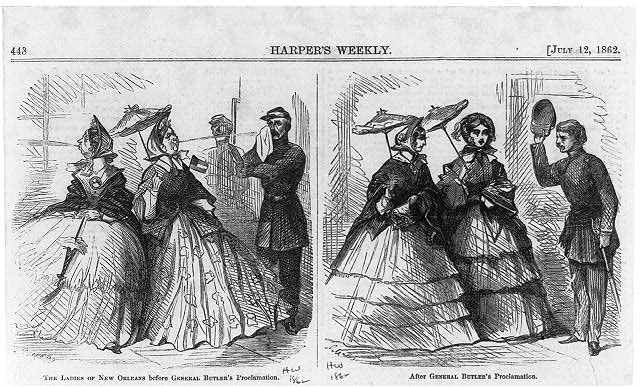
The Ladies of New Orleans before General Butler’s Proclamation; After General Butler’s Proclamation. Harper’s Weekly, July 12, 1862, p. 443.
The Backlash
The order’s reception was disproportionate to its operational footprint. Within days it had been printed as Confederate propaganda, denounced from pulpits across the South, and folded into the iconography of Yankee depravity that would sustain the Confederate cause for the remainder of the war. P. G. T. Beauregard issued the nickname Beast Butler from his command. Jefferson Davis denounced the order in his General Order No. 111 of December 1862 and declared Butler a felon deserving capital punishment who should be reserved for execution if captured.
The international circuit was the more consequential register. The British press carried the order within weeks. Lord Palmerston, then Prime Minister, condemned the spirit of the order in correspondence with the American minister Charles Francis Adams. The order was raised in the House of Commons. Butler’s image was printed on the bottom of chamber pots manufactured in Britain and shipped to the Confederacy as souvenirs of moral indignation. Within seven months Butler was removed from command of New Orleans.
What May 15 Means in the Heritage Record
May 15, 1862 belongs in the Louisiana record for what it shows about the social architecture of the occupied city. Occupation is the regulation of public space. Public space is regulated by symbols. The administrator who confuses the operational register with the symbolic register will win individual engagements while losing the war of meaning that contains them. Butler won the gestures. He lost the meaning. The historical record has remembered the meaning.
Butler won the gestures. He lost the meaning. The historical record has remembered the meaning.
Butler put it in letterpress. That was the difference. The mechanism he named in 1862, discipline a woman by stripping her of social protection and reclassifying her as available for degradation, did not end with the occupation of New Orleans. It is still in use. The version operating today is not printed and signed by command of the Department of the Gulf. It is enacted in courtrooms and newsrooms and group chats and pulpits, and the men who run it are still being protected by the same architecture of honor culture Butler tried to weaponize. Butler’s order tells on itself precisely because it was written down. What is not written down is still happening, and men who behave this way should not be protected by the institutions standing around them.
For families with roots in occupied New Orleans, in the surrounding river parishes that fed and clothed the city, in the Faubourg Tremé and the Marigny and the French Quarter, May 15, 1862 is an ancestral date. The women you descend from were inside the documentary archive of that day, whether their names appear in it or not. The line they stood on is the same line their descendants stand on now.
Who ya’ people?
Sources
Arceneaux, Pamela D. “Benjamin Butler’s Order No. 28.” The Historic New Orleans Collection. Accessed May 3, 2026. https://hnoc.org/research-collections/collection-highlights/broadside-depicting-benjamin-butler-e2-80-99s-general-order-no-28.
Brady, Mathew B., and Edward Anthony. Major General Benjamin Butler. Photograph. New York: Edward Anthony, ca. 1861–1876. From Library of Congress, World Digital Library. https://www.loc.gov/item/2021669487/.
Butler, Benjamin F. General Order No. 28. Headquarters Department of the Gulf, New Orleans, May 15, 1862. From Library of Congress. https://www.loc.gov/item/08018088/.
Campbell, Jacqueline G. “The Unmeaning Twaddle about Order 28: Benjamin F. Butler and Confederate Women in Occupied New Orleans, 1862.” Journal of the Civil War Era 2, no. 1 (March 2012): 11–30.
Capers, Gerald Mortimer. Occupied City: New Orleans under the Federals, 1862–1865. Lexington: University Press of Kentucky, 1965.
Davis, Jefferson. General Order No. 111. December 23, 1862. In The War of the Rebellion: A Compilation of the Official Records of the Union and Confederate Armies, series 2, volume 5, 795–797. Washington, DC: Government Printing Office, 1899.
Harper’s Weekly. “The Ladies of New Orleans before General Butler’s Proclamation; After General Butler’s Proclamation.” July 12, 1862. From Library of Congress, Prints and Photographs Division. https://www.loc.gov/item/2006691867/.
Hearn, Chester G. When the Devil Came Down to Dixie: Ben Butler in New Orleans. Baton Rouge: Louisiana State University Press, 1997.
Jones, Terry L. “Benjamin Butler.” 64 Parishes. Louisiana Endowment for the Humanities. Accessed May 3, 2026. https://64parishes.org/entry/benjamin-butler.