Women’s History Wednesday · Genealogy Research
Marguerite Scypion: The Louisiana Decree That Outlasted Three Sovereigns
By The Kinstructure Company · May 13, 2026 · 14 min read
On the eighth of November 1836, in a Jefferson County, Missouri courtroom carefully chosen for the distance it placed between her and the Chouteau family’s St. Louis power base, twelve men returned a unanimous verdict declaring that Marguerite Scypion, her sister, her children, and every surviving descendant of her mother were free people of color.1 That verdict ended thirty-one years of continuous litigation. It ended American Indian slavery as a legally defensible institution in the state of Missouri. And it rested on a single legal proposition rooted in Louisiana colonial law.
The Illinois Country, including Fort de Chartres and Ste. Genevieve, was Louisiana then.
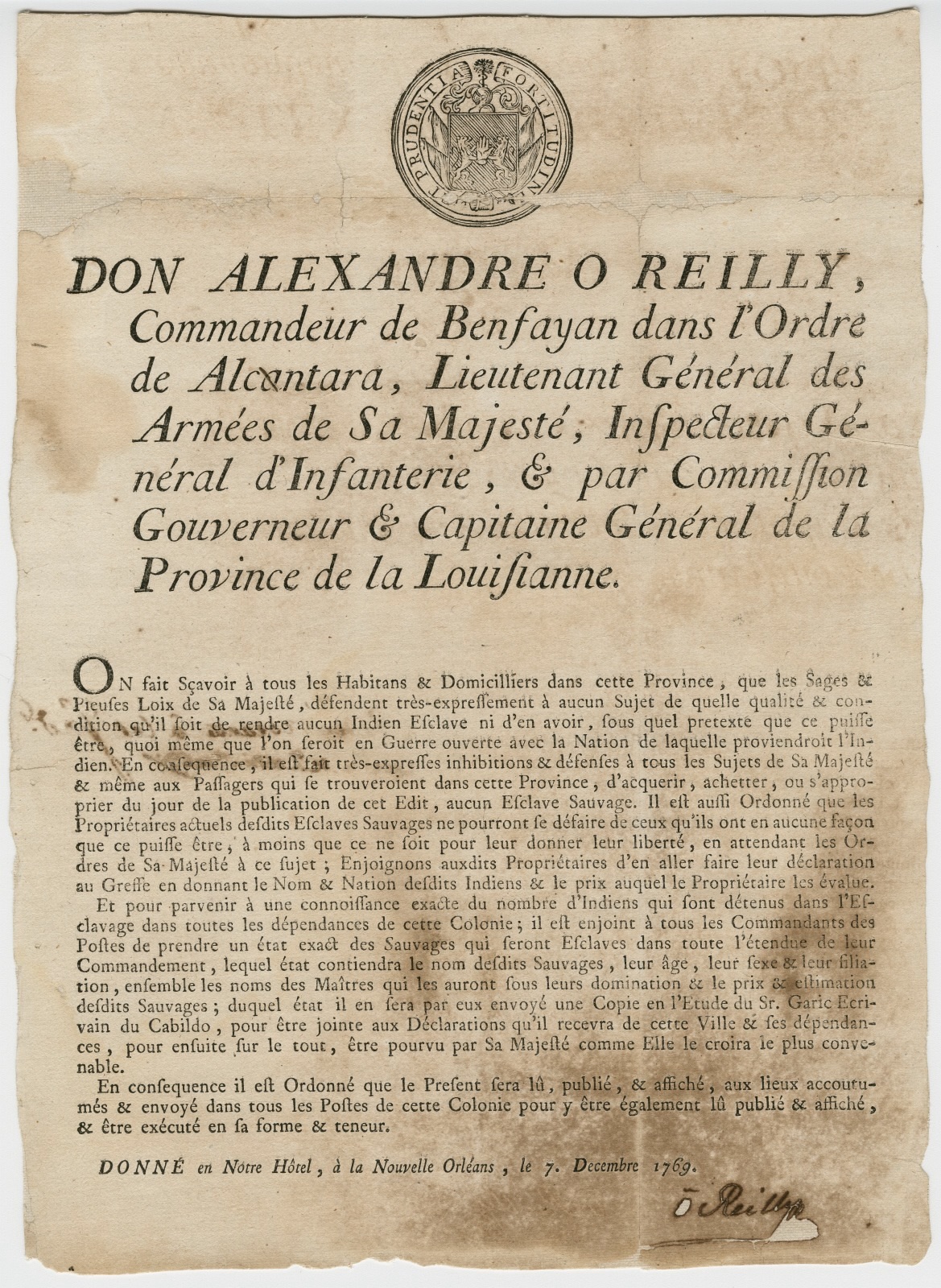
The story of Marguerite Scypion is a Louisiana heritage story, even though the courtroom sat in Missouri. The legal foundation of her case was a decree issued in 1769 by Don Alejandro O’Reilly, the Spanish Governor of the Province of Louisiana, prohibiting the enslavement of American Indians within Louisiana’s jurisdiction.2 The Illinois Country, including Fort de Chartres and Ste. Genevieve, was Louisiana then. The maternal line at the heart of this case ran through that colonial Louisiana legal regime.
The Captive Natchez Woman and Her Daughter
Marguerite Scypion’s grandmother was a Natchez Indian woman known to the surviving record only by the names Marie or Mariette. She was taken captive during the French wars of 1729 to 1731 that destroyed the Natchez nation and dispersed its survivors across the colonial slave markets of the Lower Mississippi and Caribbean. She was enslaved in the Illinois Country, in what was then the upper reach of French Louisiana.3
From this captive Natchez woman was born, near Fort de Chartres around 1744, a daughter named Marie Jean Scypion. Her father was an enslaved man of African descent called Scypion, from whom she took her surname. Marie Jean was originally enslaved by a French priest before passing to the household of Joseph Tayon, who took her with him to St. Louis after the city was founded in 1764.4 Her status at birth was governed by the French Code Noir of 1724 and by the Roman law doctrine of partus sequitur ventrem, the principle that the child follows the womb.5 That doctrine had been engineered precisely because it allowed the children of enslaved women to be born into bondage regardless of their fathers’ status.

The 1769 Proclamation
By the Treaty of Fontainebleau of 1762 and the Treaty of Paris of 1763, France ceded Louisiana west of the Mississippi to Spain. The Spanish Crown dispatched General Don Alejandro O’Reilly to assume control. O’Reilly arrived at New Orleans in August 1769 with a mandate to align Louisiana with Spanish colonial law.6 His proclamation of December 7, 1769, prohibited the enslavement of American Indians within the Province of Louisiana.

The proclamation did not free anyone in practice.
The proclamation did not free anyone in practice. Officials in St. Louis declined to enforce it under pressure from the slaveholding class. The trade and possession of Indian-descended captives continued. Eighteen years later, in 1787, Governor Esteban Rodríguez Miró republished the decree and opened the colonial courts to freedom suits by enslaved Indians, but by that date the Scypion family was a generation deeper into possession by the Tayon household.7 The proclamation, however, had entered the public record of the colony, and it gave every Indian-descended woman in Louisiana a legal argument she could carry forward across every subsequent change of sovereignty.
The Argument Preserved in the Household
Marie Jean Scypion carried that argument. The Missouri Encyclopedia entry by historian William E. Foley records that Marie Jean questioned the legality of her own bondage on the precise ground that Spanish law had outlawed Indian slavery, and that officials in St. Louis declined to enforce the prohibition under local pressure.8 That detail is critically important. It establishes that the legal argument Marguerite would later carry to court was not invented by abolitionist lawyers in the 1820s. It was preserved within the family by the woman whose legal status was the foundation of the entire claim.
Around 1799, Joseph Tayon attempted to sell Marie Jean and her daughters out of the household. The sale was blocked from within. Tayon’s own daughters, Helene Chevalier and Marie Louise Chauvin, who held the younger Scypion women as bequests from their mother, refused to surrender custody. They reminded their father that the Indian ancestry of these women made any sale legally doubtful.9 The episode created an archival record of recognition by family members and colonial authority that the freedom claim was legally defensible.
The 1805 Suit and the Long Litigation
Marguerite Scypion did not begin her legal struggle in 1825. She began it in 1805, two years after the United States took formal possession of Louisiana, when she and her sisters Catiche and Celeste filed the first freedom suit in the territorial court of St. Louis.10 The case predated the Dred Scott litigation by forty-one years. It was, by any reasonable measure, the foundational freedom action in the legal history of the Missouri country.
The territorial court initially ruled in favor of the Scypion sisters. The decision was reversed on appeal. The pattern repeated itself across three decades. Trial juries, presented with the underlying evidence, credited the freedom claim. Appellate authority, embedded in the institutional interests of the slaveholding class, repeatedly intervened to overturn those verdicts.
In 1824, the Missouri General Assembly enacted a statute permitting persons held in slavery to sue for their freedom as poor persons, with counsel appointed by the court.11 Marguerite renewed her case in July 1825 under the new statute, naming Pierre Chouteau Sr. as defendant. The court appointed three attorneys to represent her, including Hamilton Gamble, the future Missouri governor who would later dissent in Dred Scott. The pleading was framed as an action in trespass for false imprisonment, with damages laid at five hundred dollars.12 The complaint did not ask the court to bestow freedom. It asserted that her freedom already existed under the 1769 decree and demanded damages for its violation.
The Missouri Supreme Court and the Change of Venue
The case moved through the Missouri Supreme Court in 1834, with Judge George Tompkins supporting Marguerite, Judge Robert Wash supporting Chouteau, and Justice Mathias McGirk casting the decisive vote on rehearing. The majority ordered a new trial. Judge Wash dissented, arguing that the Treaty of Cession of 1803 had constitutionalized the slaveholders’ existing property rights and that to free Marguerite was to confiscate Chouteau’s property in violation of federal treaty obligations.13 The majority rejected that architecture.
The venue was transferred first to St. Charles County and then to Jefferson County, on the documented ground that the political and economic power of the Chouteau family in St. Louis precluded an impartial jury.14 The change of venue was itself a remarkable procedural acknowledgment. The court was conceding, on the record, that justice could not be done in the city the Chouteaus controlled.
The Jefferson County Verdict and the Supreme Court
On the eighth of November 1836, the Jefferson County jury returned a unanimous verdict for the plaintiffs. The related actions by the descendants of Catiche and Celeste were rolled into the same proceeding, so that the freedom of every surviving descendant of Marie Jean Scypion was determined at once.15 The Missouri Supreme Court affirmed.
Pierre Chouteau Sr. pursued a writ of error to the Supreme Court of the United States. The case was decided in the January Term of 1838 and reported as Chouteau v. Marguerite, 37 U.S. (12 Pet.) 507. The Court dismissed the writ on jurisdictional grounds, holding that the question whether Marguerite was a slave was a question of state law, not of federal treaty interpretation.16 The Missouri judgment was left undisturbed. The same Court that nineteen years later would decide Dred Scott v. Sandford in the opposite direction had, in 1838, declined to interfere with a state-court verdict freeing an entire family of African-Natchez descent.
She Argued the Proof Until the Law Caught Up
Marguerite Scypion took the slaveholders’ favorite doctrine, partus sequitur ventrem, and turned it into the instrument of their defeat. She argued, and her family argued for thirty-one years, that the line that ran through her mother and her mother’s mother was a deed of title to her own body, registered in Louisiana law on the seventh of December 1769. In November 1836, a jury of twelve men finally agreed.
In November 1836, a jury of twelve men finally agreed.
She should be remembered as one of the foundational figures of American liberty. The omission of her name from the canon is itself the evidence. She wrote the proof. She prosecuted the case. She outlasted the dissent.
Her name is Marguerite Scypion. Her grandmother was a Natchez woman called Marie. Her freedom ran through the maternal line of a Louisiana colonial household. We are calling her by name.
Who ya’ people?
Notes
- Verdict and judgment, Marguerite v. Chouteau, Jefferson County Circuit Court, 8 November 1836; Missouri State Archives, Jefferson County Circuit Court Minute Book 2, Files 273 and 274; affirmed Missouri Supreme Court.
- Don Alejandro O’Reilly, Proclamation ending Indian slavery in the Province of Louisiana, 7 December 1769, The Historic New Orleans Collection, 67-28-L (catalog.hnoc.org); full text in Lawrence Kinnaird, ed., Spain in the Mississippi Valley, 1765–1794, 3 vols. (Washington: Government Printing Office, 1949).
- William E. Foley, “Scypion, Marie Jean,” Missouri Encyclopedia, State Historical Society of Missouri (missouriencyclopedia.org/people/scypion-marie-jean); Carl J. Ekberg, French Roots in the Illinois Country: The Mississippi Frontier in Colonial Times (Urbana: University of Illinois Press, 1998), 145–175; Stuart Banner, How the Indians Lost Their Land: Law and Power on the Frontier (Cambridge: Harvard University Press, 2005), 49–50.
- Foley, “Scypion, Marie Jean.”
- Louis XV, Code Noir, March 1724 (Louisiana edition), Library of Congress (loc.gov/item/2021667007); English translation by Vernon Valentine Palmer, Tulane European and Civil Law Forum.
- O’Reilly, Proclamation of 7 December 1769; “Slavery in Spanish Colonial Louisiana,” 64 Parishes, Louisiana Endowment for the Humanities (64parishes.org/entry/slavery-in-spanish-colonial-louisiana).
- “Slavery in Spanish Colonial Louisiana,” 64 Parishes; Foley, “Scypion, Marie Jean.”
- Foley, “Scypion, Marie Jean”; William E. Foley, “Slave Freedom Suits before Dred Scott: The Case of Marie Jean Scypion’s Descendants,” Missouri Historical Review 79 (October 1984): 1–23.
- Foley, “Scypion, Marie Jean.”
- Foley, “Slave Freedom Suits before Dred Scott”; Lea VanderVelde, Redemption Songs: Suing for Freedom before Dred Scott (New York: Oxford University Press, 2014), chap. 1.
- An Act to Enable Persons Held in Slavery to Sue for Their Freedom, Mo. Rev. Stat. 1824, ch. 69.
- Petition and declaration in trespass, Marguerite, a Free Woman of Color v. Pierre Chouteau, Sr., July 1825, Case No. 16, St. Louis Circuit Court Records, Missouri Historical Society, St. Louis; Washington University Freedom Suits collection (repository.wustl.edu/concern/texts/b2773w92s).
- Marguerite v. Chouteau, 3 Mo. 540, 562 (1834), Wash, J., dissenting.
- Order of change of venue, Marguerite v. Chouteau, St. Charles to Jefferson County Circuit Court, 1835, Missouri Judicial Records.
- Verdict, Marguerite v. Chouteau, Jefferson County Circuit Court, 8 November 1836; Foley, “Slave Freedom Suits before Dred Scott”; VanderVelde, Redemption Songs.
- Chouteau v. Marguerite, 37 U.S. (12 Pet.) 507, 511–515 (1838) (supreme.justia.com/cases/federal/us/37/507; law.cornell.edu/supremecourt/text/37/507).