Women’s History Wednesday · Genealogy Research
Rose Nicaud of the French Market: The Coffee Woman the Legend Could Not Hold
She sold coffee in the French Market for forty years, and the legend kept only the part of her that cost the city nothing. The full record is larger, and the full record is the one that honors her.
By The Kinstructure Company · june 10, 2026 · 13 min read
Every visitor account of the old French Market reaches, sooner or later, for the same woman. She is the coffee seller. They called her Old Rose. Her cafe au lait was described as a benediction, her stand as a kind of pilgrimage, her death as the end of an era. The legend is durable precisely because it is simple. An enslaved woman saved her coffee earnings, bought her freedom, and became the most beloved vendor in the city. That version has been told in newspapers, novels, and tour scripts for more than a century, and a Faubourg Marigny coffeehouse carried her name for two decades.
The legend is also, in its tidy form, smaller than the truth. The full documentary record of Rose Nicaud’s life is larger and harder than the inspirational version can hold, and it is the larger record that honors her. The question worth asking is not whether she was admirable. The question is what her documented life reveals about the system that produced it, and about how a small number of Black women in a slave society converted skill, mobility, and market position into freedom and capital.
A life becomes doctrine only when it is read in full. The parts the legend omits are the parts that carry the lesson.
Property Before Personhood
Rose was born in 1812 or 1813 in the household of Diego Morphy, the Spanish consul to New Orleans and grandfather of the chess prodigy Paul Morphy. Her earliest appearance in the record is not a baptism. It is an estate inventory. Her mother Nelly appears on the 1814 inventory of Diego Morphy’s estate, described as negresse americaine, a designation indicating both a dark complexion and an origin outside Louisiana, most likely South Carolina, where the Morphy family had lived before relocating in 1809. Rose was the third of Nelly’s six known children. Her personhood enters history as a line item in the accounting of a dead man’s assets.
On December 7, 1819, the Widow Morphy sold Nelly and her six children, Rose then six years old, to Paul Rossignol des Dunes Poincy, a baker and native of Saint-Domingue. This was the first of six transactions between 1819 and 1839 that moved Rose and her family among a closely linked group of commercial bakers, most of them refugees of the Haitian Revolution. The bakery trade of the French Quarter was, to a striking degree, a Saint-Domingue trade, and Rose’s family was its property. In 1831 the family was sold to the baker Michel Nicaud, whose bakery stood on Chartres Street, and it is from him that Rose carried the Nicaud name. She grew up working as a marchande de pain, a bread seller, as did her mother and her sisters Venus, Becky, and Fanny.
Here the record yields its first counterintuitive fact. The six sales, though violent disruptions, did not separate the family. Because the buyers were neighbors and kin to one another, Nelly and her children moved together and remained within a few blocks of the same Quarter streets.
A family sold six times but never broken kept the relationships, skills, and standing that a scattered family loses. The market that traded them also, by its own tight geography, preserved them.
The One Unguarded Door
Slavery in New Orleans was not the slavery of the cane fields. Urban enslaved people who worked as bakers and street vendors moved through the city with a latitude unthinkable on a rural plantation. They negotiated, they handled money, they interacted daily with the wider population. That mobility was not freedom. It was a feature of the labor system, and it was the precondition for everything Rose did next.
Three forces converged to create her opening. Louisiana permitted the enslaved a day of rest on Sunday, and many used it to sell their own goods and keep a portion of the proceeds. For the street-selling women, that Sunday economy was a documented pathway to self-purchase, and enslaved women between sixteen and forty-nine were considerably more likely to buy their freedom than enslaved men. The city was also one of the largest coffee ports in the country by the 1840s, with the mouth of the Mississippi serving as the logical entry point for Caribbean and South American beans. The French Market itself was open and public, a single unregulated space where a vendor with a superior product could build a clientele across every line the rest of the city worked to keep separate.
Rose read these forces correctly. She began selling coffee in the early 1840s, first from a pushcart, likely working the cathedral crowds on Sunday mornings before establishing a permanent stand. Coffee was the right commodity for a reason that had nothing to do with sentiment. Market workers opened their stalls before dawn and needed it, which guaranteed demand at the exact hours she could command the space. She had found one rung of the coffee economy that custom and law left open to a free woman of color, and she stood on it for more than forty years.
Opportunity is not the absence of constraint. It is the precise gap the constraints leave open, found by someone positioned to see it. Rose located the one unguarded door and built a business in the doorway.
The Mechanics of Freedom
The popular account says she bought her freedom with coffee money. The record is more specific and, on one point, silent. In late 1838 Michel Nicaud petitioned the Orleans Parish Police Jury to manumit Rose. The jury considered and approved the petition in two meetings, on November 30, 1838, and March 1, 1839. The notarial act that would have formally executed her freedom has not been located. The conclusion that she was free rests instead on a later record. By June 1840 she appears in the federal census as a free woman of color and the head of her own household, about twenty-seven or twenty-eight years old, living on Ursulines Street.
Honest method requires naming the gap rather than filling it with the legend. The police-jury approval and the free-status enumeration together establish that manumission occurred in that window. They do not by themselves prove that coffee earnings were the consideration, nor do they recover the instrument of freedom. The defensible statement is narrow. Rose gained her freedom between March 1839 and June 1840 through a manumission initiated by Michel Nicaud and approved by the police jury, by means the surviving record does not fully disclose.
Where the record goes silent, the scholar marks the silence. A named gap is stronger than a borrowed certainty, because the gap can be closed by the next document and the borrowed certainty cannot survive it.
Freedom as a Family Instrument
Rose’s freedom did not detach her from the enslaved community. It armed her to act within it. On February 7, 1848, using the surname Williams, she testified in the freedom suit of her sister Fanny against the Widow Bouny. Fanny argued that her enslaver, by taking her to France, had effectively freed her and owed her back wages, a legal logic that anticipated the argument Dred Scott would bring before the Supreme Court nine years later. Rose’s testimony was concrete and economic. She swore that Fanny was a good bread seller and that bread sellers were generally paid twenty to twenty-five dollars a month, establishing the value of the labor for which Fanny sought compensation. Fanny won her freedom.
This episode reframes the entire portrait. Rose was not a solitary entrepreneur. She was a node in a family network that deployed the courts, sworn testimony, and the documented wage value of skilled vending as instruments of liberation. The same market knowledge that made her coffee profitable made her testimony decisive. She knew what a bread seller was worth because she had been one, and she converted that knowledge into a sister’s freedom.
The Hard Variable
The 1850 federal census enumerates Rose under the name Rose Williams in the French Quarter, living with two young women whom she enslaved. The New Orleans conveyance books for the 1850s show her purchasing and selling at least three young women across the decade. The evidence does not permit evasion, and the responsible reading does not attempt it. Rose likely put these women to work as marchandes or hired out their labor as domestics. With enslaved-person prices climbing steeply through the 1850s, they functioned as capital, both as labor and as appreciating assets that could be sold.
The mechanism here is structural, and it must be stated plainly. In a slave society, a Black woman who had escaped bondage had almost no lawful, durable means of storing and growing wealth. She could not vote, hold most offices, or rely on the protection of courts that regarded her as barely a citizen. Real property was precarious and could be contested. The one asset class that was liquid, appreciating, legally protected, and socially normalized was human beings. Rose did not invent that logic. The society engineered it and then offered it to her as the rational path to security. She took it. The tragedy is not that she was uniquely compromised. It is that the system made the ownership of others the obvious instrument of a freed woman’s self-protection.
To rise inside a corrupt structure is, absent a deliberate refusal, to be conscripted into its maintenance. A story that ends at manumission teaches that freedom is a finish line. The full record teaches something harder.
Named in the City’s Own Hand
In June of 1854 the city set Rose down in its own official record. On the New Orleans tax rolls printed in the Daily Picayune, under the letter N, the entry reads Rose Nicaud, f. w. c. The initials stand for free woman of color. The city was naming her, in its own hand, as a free woman who held property and answered for it like any other taxpayer in New Orleans. That single line is one of the few times the public record recognized her in writing while she was alive and working, and it recognized her as free. The following year, in February of 1855, she married Oscar Nezat, a free man of color, at St. Augustine Church in Faubourg Treme, and the two were enumerated together in 1860 before their marriage ended in divorce.
Embalmed in Amber
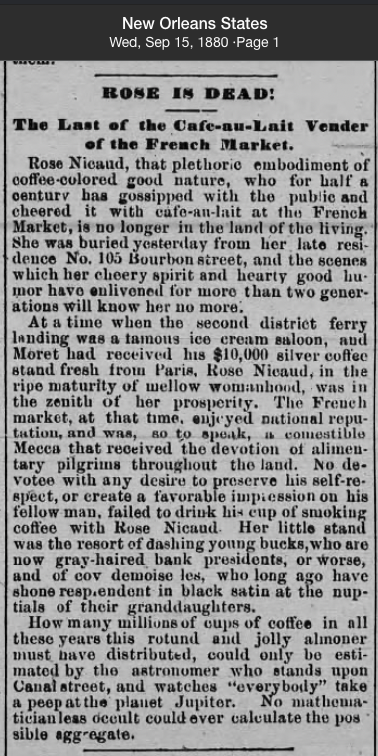
Rose Nicaud died of apoplexy on September 13, 1880, at sixty-eight, at her last residence on Bourbon Street. She was interred in the tomb of the Societe des Fleurs de Marie, an antebellum benevolent society of women of color, in St. Louis Cemetery No. 2. Two days after her death the New Orleans States announced it on the front page under a headline naming her the last of the cafe-au-lait venders of the French Market. The notice recalled her cheery spirit and her hearty good humor and said that two generations had known her at her stand. It is a warm notice, and it is also the kind of warm notice a city writes about a woman it loved without ever quite reckoning with her.
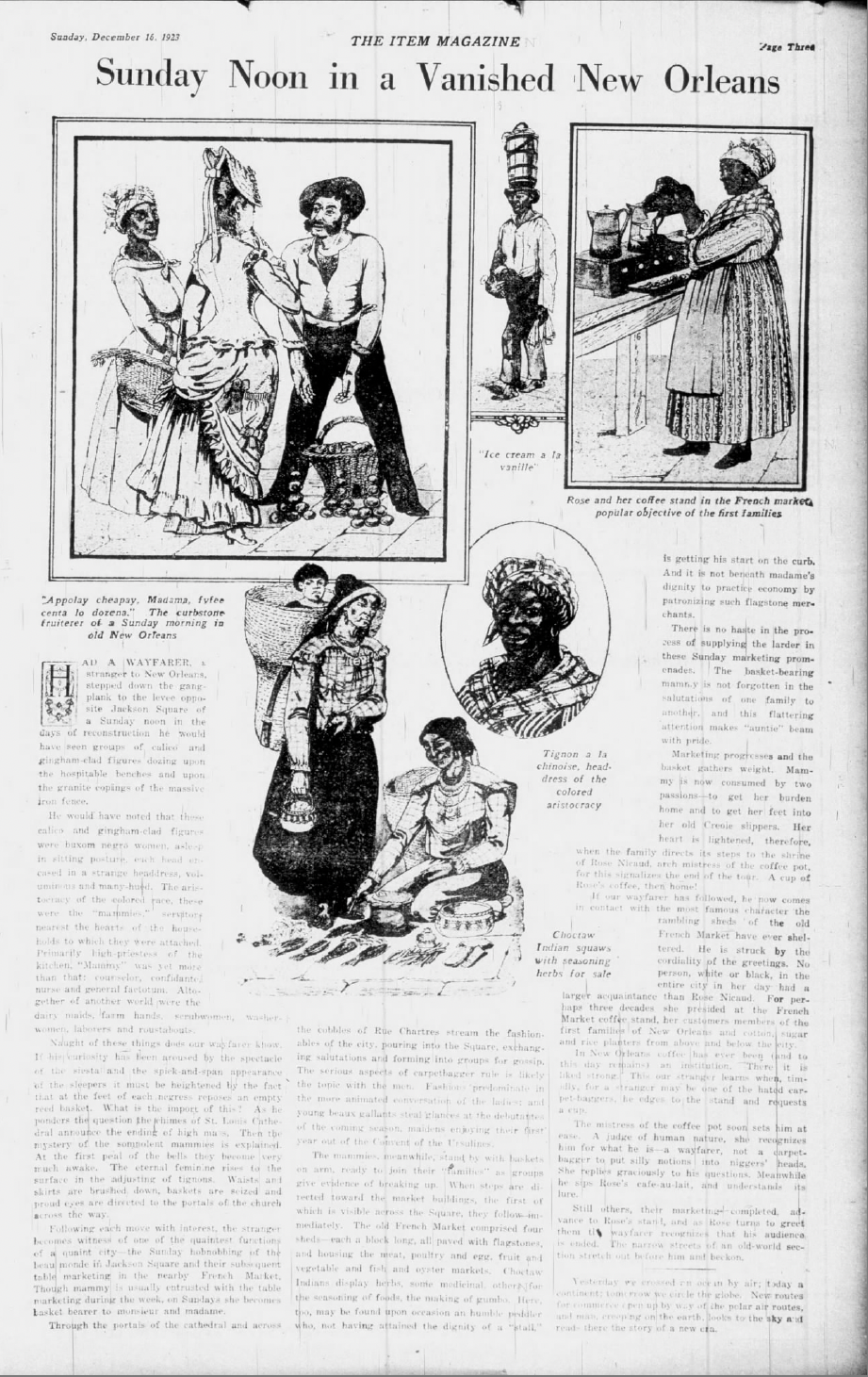
The legend was sealed a generation later, when a journalist preserved Rose in a French Market pamphlet and pronounced her memory embalmed in the amber of local song and story. The verb is exact. Embalming preserves by removing what decays. The amber that kept Rose’s memory bright did so by sealing out the conveyance books and the 1850 census, the records of the women she owned. A society preserves the version of a person that costs it nothing and discards the version that would require an accounting. The recovery of the full record, more than a century later, is the work of taking her back out of the amber.
Memory is not neutral. To recover the discarded record is itself an act of repair.
What the Record Proves
Rose Nicaud’s life resolves into a single demonstrable proposition. Under American slavery, a narrow structural opening could be converted by an exceptionally positioned woman into freedom, capital, and lasting reputation, and the same opening, because it existed inside the property regime rather than outside it, drew the freed woman back into that regime as its beneficiary. The coffee was real and the talent was real, and neither caused the outcome alone. The intact family, the bakery network, the Sunday market, and the open ground of the French Market were the conditions without which the coffee earned nothing.
The instructive value of her life lies precisely where the legend refuses to look. She proves that rising inside an unjust system is not the same as defeating it, and that the memory a society chooses to preserve is engineered to spare that society an accounting. These are not comfortable lessons, and they are the reason her story is worth telling in full. The coffee woman of the French Market was not a saint and not a villain. She was a free woman of color who held a working corner of the city on her own footing for forty years, and the whole of her record honors her more than the legend ever did.
Her name is Rose Nicaud. The record carried her in initials and the city carried her in legend. We are carrying her by name, and we are carrying the whole of her.
Who ya’ people? ⚜️
Bibliography
“Official Tax List, State of Louisiana, City of New Orleans, Parish of Orleans: To All Delinquent Tax-Payers.” The Daily Picayune (New Orleans, La.), June 9, 1854, p. 4. Digital image. Newspapers.com. https://www.newspapers.com/image/25554222/.
“Rose Is Dead: The Last of the Cafe-au-Lait Venders of the French Market.” New Orleans States (New Orleans, La.), September 15, 1880, p. 1. Digital image. Newspapers.com. https://www.newspapers.com/image/1317319594/.
Honora, Jari C. “The Untold Story of Rose Nicaud, Coffee Queen of New Orleans.” First Draft (blog). Historic New Orleans Collection, September 24, 2025. https://hnoc.org/publishing/first-draft/coffee-seller-rose-nicaud-and-her-journey-from-enslavement-to-entrepreneurship.
“Sunday Noon in a Vanished New Orleans.” The Item Magazine (New Orleans, La.), December 16, 1923, p. 3. Digital image. Newspapers.com. https://www.newspapers.com/image/1321324917/.