THIS DAY IN LOUISIANA HISTORY · MAY 7, 1718
The Traditional Birthday of New Orleans: May 7, 1718
May 7 is the traditional anniversary of the founding of New Orleans.
BY THE KINSTRUCTURE COMPANY · MAY 7, 2026 · 6 MIN READ
On this date, by long custom, Louisiana governor Jean-Baptiste Le Moyne de Bienville is said to have planted the first stake of La Nouvelle-Orléans on a crescent bend of the Mississippi River, roughly one hundred miles above its mouth. He named the new settlement for Philippe II, Duke of Orléans, regent of the Kingdom of France during the minority of Louis XV.
The story is older than the date.
The Strategic Logic of the Crescent
The strategic logic of the location was Bienville’s own. In 1717 he wrote to the Company of the West proposing a settlement on a crescent bend of the river that he believed safe from tidal surges and hurricanes. Permission came back across the Atlantic that autumn. By the winter of 1718 he was at Mobile preparing six vessels and 43 men for the voyage. By early spring his expedition had anchored at the upper bank of what is now the French Quarter. The colonist Jonathan Darby would later recall that Bienville cut the first cane, and that thirty workers, all of them convicts, cleared the dense canebrake near present-day North Peters Street and Conti.
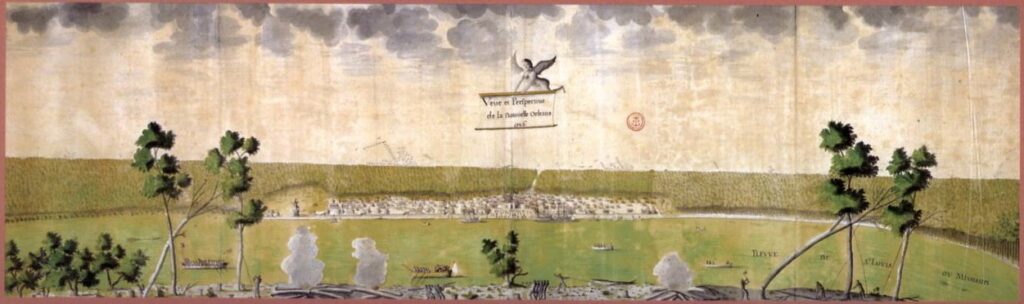
Jean-Pierre Lassus, Veüe et Perspective de la Nouvelle Orleans, 1726. The earliest known view of the city, painted eight years after the founding. Archives nationales d’outre-mer, Aix-en-Provence.
What the Record Actually Shows
The truth is that the actual day of founding is not in the documentary record. Bienville himself wrote on June 12, 1718, only that work was underway on the establishment of New Orleans, thirty leagues above the entrance to the Mississippi. The Louisiana Historical Society declared in March 1918 that the founding occurred between February 9 and 11, 1718. Tulane geographer Richard Campanella has documented that the May 7 tradition gained momentum after the city’s 250th anniversary banquet, held at The Roosevelt on May 7, 1968, rather than from any 1718 archival source.
The truth is that the actual day of founding is not in the documentary record.
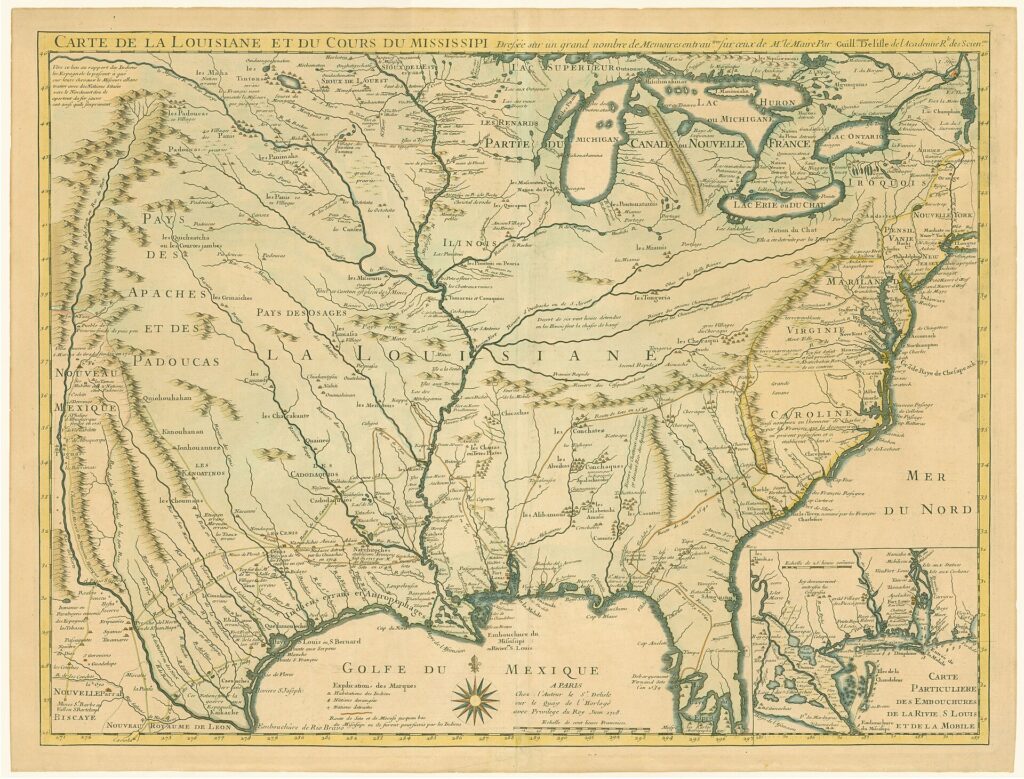
Guillaume Delisle, Carte de la Louisiane et du Cours du Mississipi, Paris, June 1718. Published the same year New Orleans was founded. The city is a small notation at the mouth of the river. Library of Congress, Geography and Map Division.
The land carries an older name still.
Bulbancha
Long before Bienville, the Bayougoula, the Houma, the Chitimacha, and other Indigenous nations used the high ground at the bend of the river as a portage and a meeting place. The land was known as Bulbancha, the place of many tongues, because traders and travelers from many nations met there to do business in the languages of the Mississippi. New Orleans inherited the geography of Bulbancha and, in time, much of its character.
The land was known as Bulbancha, the place of many tongues.
From Outpost to Capital
By 1721 the engineer Adrien de Pauger had drawn the eleven-by-seven block grid that still anchors the Vieux Carré. By the summer of 1722 the colonial capital had moved from Biloxi to the new city. By 1723 New Orleans was the seat of French Louisiana.
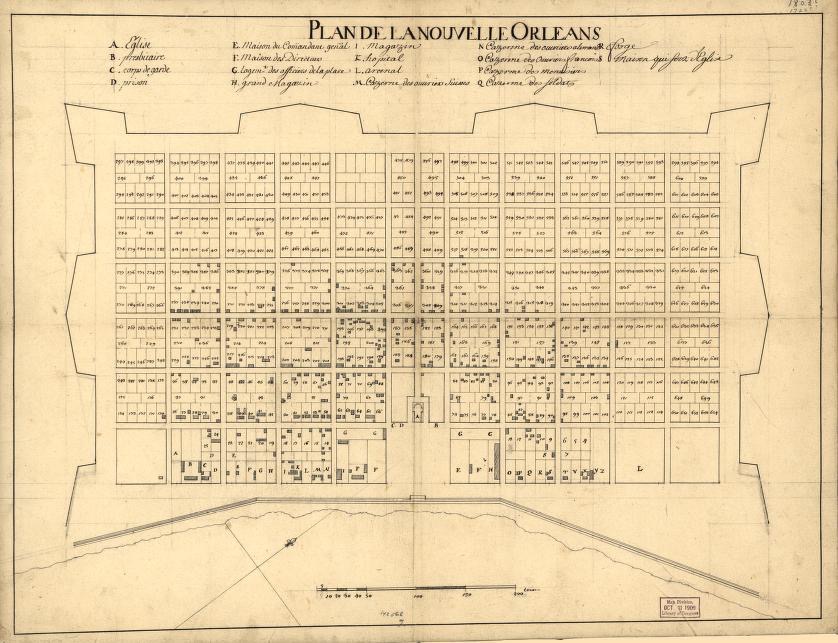
Plan de la Nouvelle Orleans, ca. 1722. Attributed to Adrien de Pauger. The eleven-by-seven block grid that still anchors the Vieux Carré. Library of Congress, Geography and Map Division.
Three hundred and eight years later, the descendants of the Indigenous, French, Spanish, African, Caribbean, and Creole peoples who built the city on that crescent bend live in every state of the union. The culture they carry was forged at that bend in the river. The diaspora that carries it forward is the proof that the city was always more than a date on a calendar.
Today is the traditional birthday. We mark it with the documented record and the names that came before it.
Who ya’ people?
Sources
American Battlefield Trust. “The Founding of New Orleans.” Updated June 12, 2024. https://www.battlefields.org/learn/articles/founding-new-orleans.
Bibliothèque nationale de France. “New Orleans, 1718-1769.” France in America. https://heritage.bnf.fr/france-ameriques/en/new-orleans-1718-1769.
Campanella, Richard. “How New Orleans was founded in 1718: Indecision, contingency, discord and serendipity.” NOLA.com, January 10, 2018.
Powell, Lawrence N. The Accidental City: Improvising New Orleans. Cambridge: Harvard University Press, 2012.
WWL-TV. “VERIFY: Does New Orleans have an actual birthday?” wwltv.com.
Image Sources
Jean-Baptiste Le Moyne, Sieur de Bienville. Eighteenth century. American School. Oil on canvas, 80.8 × 64.9 cm. The Historic New Orleans Collection, New Orleans, accession 1990.49, acquired through the Clarisse Claiborne Grima Fund. https://commons.wikimedia.org/w/index.php?search=Portrait+of+Jean-Baptiste+Le+Moyne%2C+Sieur+de+Bienville&title=Special%3AMediaSearch&type=image.
Jefferys, Thomas, and Louis Brion de la Tour. Plan of New Orleans the Capital of Louisiana; with the Disposition of its Quarters and Canals as they have been Traced by Mr. de la Tour in the Year 1720. London: Thomas Jefferys, 1759. Geography and Map Division, Library of Congress, Washington, DC. https://www.loc.gov/resource/g4014n.ar167700/?r=-0.195,-0.007,1.406,0.771,0.
Lassus, Jean-Pierre. Veüe et Perspective de la Nouvelle Orleans. 1726. Ink and watercolor on paper, 48 × 151.5 cm. Original held by Archives nationales d’outre-mer, Aix-en-Provence, France, FR ANOM 04DFC71A. https://commons.wikimedia.org/wiki/File:NouvelleOrleans1726LassusA.jpg.

L’Isle, Guillaume de. Carte de la Louisiane et du Cours du Mississipi. Paris: Chez l’Auteur le Sr. Delisle sur le Quay de l’Horloge, June 1718. https://commons.wikimedia.org/wiki/File:1718_Carte_de_la_Louisiane_et_du_Cours_du_Mississipi_by_Guillaume_Delisle.jpg.

Plan de la Nouvelle Orleans. Ca. 1722. Attributed to Adrien de Pauger. Manuscript map, ink on paper. Geography and Map Division, Library of Congress, Washington, DC. https://www.loc.gov/resource/g4014n.lh000960/?r=-0.423,-0.071,1.557,0.853,0.
Santerre, Jean-Baptiste, attributed to. Philippe II, Duke of Orléans. Ca. 1715-1716. Oil on canvas. Original held by Museo Nacional del Prado, Madrid. https://commons.wikimedia.org/w/index.php?search=Portrait+of+Philippe+II%2C+Duke+of+Orl%C3%A9ans%2C+regent+of+France&title=Special%3AMediaSearch&type=image.