Genealogy Gems · Genealogy Research
When the Citation Cannot Be Verified: How to Audit Compiled Research Before You Rely On It
A four-step method for auditing compiled research before you rely on it.
By The Kinstructure Company · June 11, 2026 · 6 min read
There is a citation in a compiled research source on your family. The researcher quoted it. The footnote looks legitimate. The author name, the title, the publication year, the page range are all there. The next researcher cited it. The lineage application cited it. The family history book cited it. By the time you find it, the citation has been repeated for thirty years.
Then you go to verify it and it does not exist.
Unverifiable citations are one of the most widespread problems in compiled genealogical research. A citation that looks legitimate but cannot be located in any library catalog, any archival finding aid, any digital repository, or any peer-reviewed index has either been miscited beyond recognition or fabricated outright. Either way, the work that rests on it is built on sand.
The discipline of auditing every citation in compiled research before relying on it is one of the most important skills a serious researcher develops. It is also one of the least practiced. The typical workflow accepts citations on the strength of the researcher who carried them forward, not on the strength of the citation itself. When the citation later turns out to be unverifiable, every conclusion built on it has to be rebuilt from a different foundation.
This installment introduces a four-step method for auditing citations in compiled research before they break your work.
A citation is not credible because someone has been quoting it for thirty years.
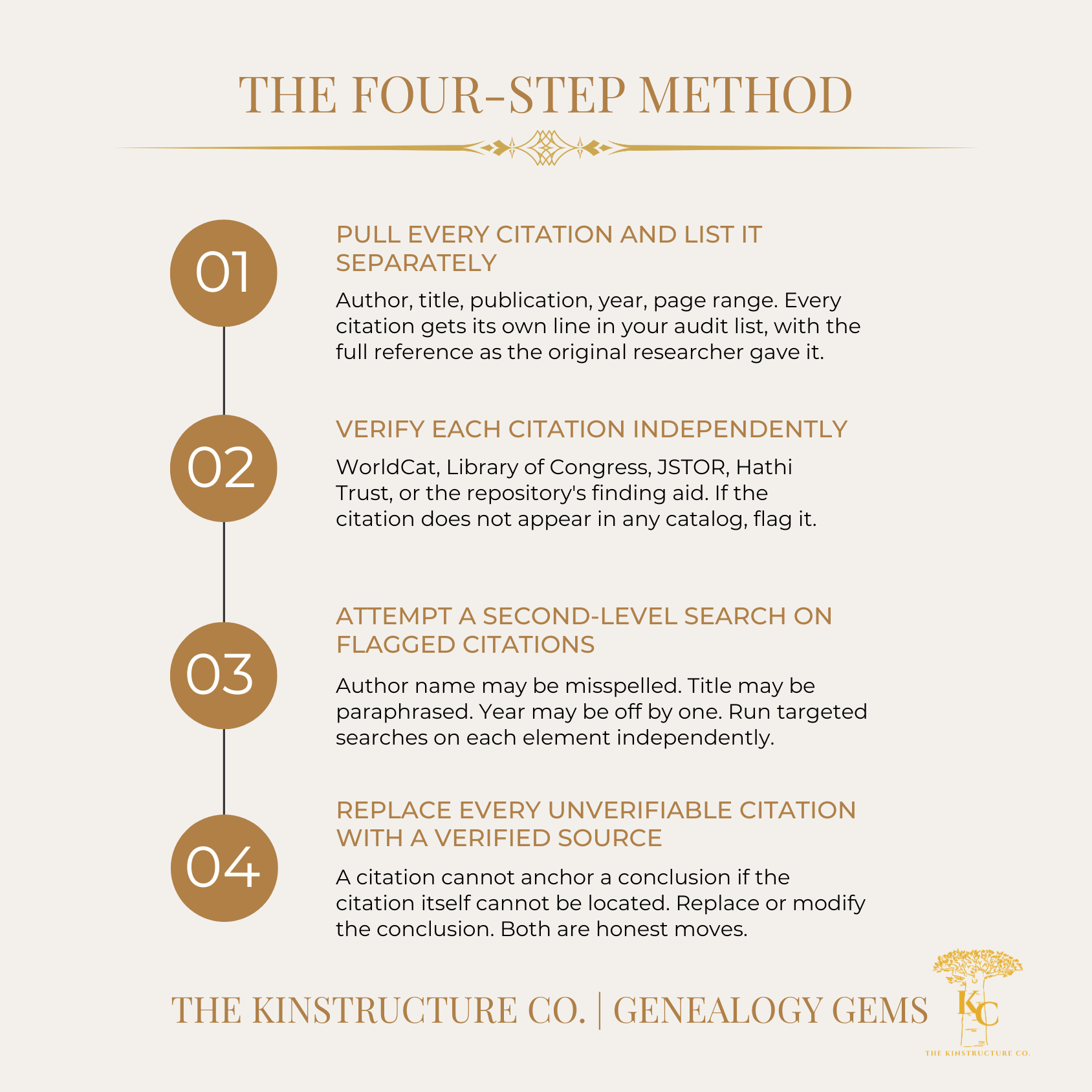
Step One: Pull Every Citation in the Compiled Source and List It Separately
Author. Title. Publication or repository. Year. Page range or document identifier. Every citation gets its own line in your audit list, with the full citation as the original researcher gave it. No paraphrasing. No truncation. The list is your audit plan.
Step Two: Verify Each Citation Independently in at Least One Authoritative Catalog or Finding Aid
For published works, search WorldCat, the Library of Congress catalog, JSTOR, the Hathi Trust, or the catalog of the relevant university press. For archival records, search the holdings of the repository where the document is held, using the finding aid or the digital collections database. For primary source documents, locate the document in the repository where it is held and confirm that the citation matches the actual record. If the citation does not appear in any catalog, finding aid, or repository, flag it.
Step Three: For Flagged Citations, Attempt a Second-Level Search Before Concluding the Citation Cannot Be Verified
Sometimes a citation is real but miscited. The author’s name may be misspelled. The title may have been shortened or paraphrased. The publication year may be off by one. The page range may have been transposed. Run a targeted search on each element of the citation independently. Search the author’s name and the topic. Search the title and the approximate year. Search the publication and the subject. If any of these searches surface the actual citation, correct your audit list and move on. If none of them do, the citation is unverifiable.
Step Four: Replace Every Unverifiable Citation with a Verified Source Before Any Conclusion Rests On It
This is the discipline that protects your work. An unverifiable citation cannot anchor a conclusion. If the conclusion in the compiled research depended on that citation, the conclusion has to be re-supported with a verified source or treated as an open question. Replacing the citation may require locating a different source that supports the same conclusion, or it may require modifying the conclusion to reflect what verified sources actually support. Both are honest moves. Carrying the unverifiable citation forward is not.
The Method in Practice
In researching the Marguerite Scypion case for the May 13 Women’s History Wednesday feature, a compiled source on the case cited a work attributed to Anne S. Dailey, titled The Scypion Sisters, presented as supporting documentation for one of the case’s biographical details. The citation appeared in the compiled source with what looked like a complete reference. Author name, title, publication context.
The audit surfaced the following.
A search of WorldCat returned no record of a published work by Anne S. Dailey titled The Scypion Sisters. A search of the Library of Congress catalog returned no record. A search of JSTOR, Hathi Trust, Google Books, and the catalogs of major university presses returned no record. A second-level search on the author name surfaced no scholar named Anne S. Dailey publishing in the field of slavery studies, Missouri history, or Spanish colonial Louisiana. A second-level search on the title surfaced no published work by that title, by Dailey or by any other author.
The Dailey citation could not be verified in any authoritative catalog. The work either did not exist, was so miscited that no element of the citation matched a real source, or had been fabricated and propagated through subsequent compiled research.
The Foley 1984 article in the Missouri Historical Review, which is verifiable in JSTOR and in the Missouri Historical Review’s published index, supported the same biographical detail. The Foley citation replaced the Dailey citation in the working source list. Every conclusion in the Scypion package that would have rested on the Dailey citation was re-supported from Foley, from VanderVelde’s Redemption Songs, or from the primary court records themselves.
Audit every citation. Verify what you can. Replace what you cannot.
Why This Matters
A citation is not credible because someone has been quoting it for thirty years. A citation is credible because it can be located, examined, and confirmed by the person relying on it. Anything less is inherited claim presented as documented fact.
The Scypion build sequence is now complete. The May 13 Women’s History Wednesday feature documented Marguerite Scypion’s life and legal victory. The May 21 Genealogy Gems installment taught the discipline of distinguishing what a primary document literally says from what later litigants and descendants argued it meant. This installment closes the sequence by teaching the discipline that surfaced the corrected citation in the first place.
Audit every citation. Verify what you can. Replace what you cannot. The work either rests on verified sources or it does not.
Who ya’ people? ⚜️
Bibliography
Chouteau v. Marguerite, 37 U.S. 507 (1838).
Foley, William E. “Slave Freedom Suits before Dred Scott: The Case of Marie Jean Scypion’s Descendants.” Missouri Historical Review 79, no. 1 (October 1984): 1-23.
Marguerite v. Chouteau, 3 Mo. 540 (1834).
O’Reilly, Don Alejandro. Proclamation banning the trade in Indian slavery, Province of Louisiana, 1769. Historic New Orleans Collection, THNOC 67-28-L.
VanderVelde, Lea. Redemption Songs: Suing for Freedom Before Dred Scott. New York: Oxford University Press, 2014.