Genealogy Gems · Genealogy Research
When You Are Not the First Researcher in the Room: Working from Compiled Records Without Inheriting Their Conclusions
A four-step method for working from compiled records without inheriting their conclusions.
By The Kinstructure Company · April 15, 2026 · 5 min read
If a researcher hands you their compiled work on your ancestor, the temptation is to read it like a book and accept what it tells you. That is not research. That is acceptance..
Compiled records, published genealogy articles, parish histories, lineage society applications, family historian notebooks, and unpublished manuscripts shared between researchers are not source documents. They are research maps. They tell you where another person has already looked. They tell you what they concluded after looking. They do not tell you whether their conclusions hold under independent verification.
A compiled record is a starting point, not an ending point. The discipline of working from one without inheriting its conclusions is a separate skill from doing the original research yourself, and it is the skill most often missing in family genealogy work that has been passed down through several hands.
This installment introduces a four-step method for using compiled research the right way.
A compiled record is a starting point, not an ending point.
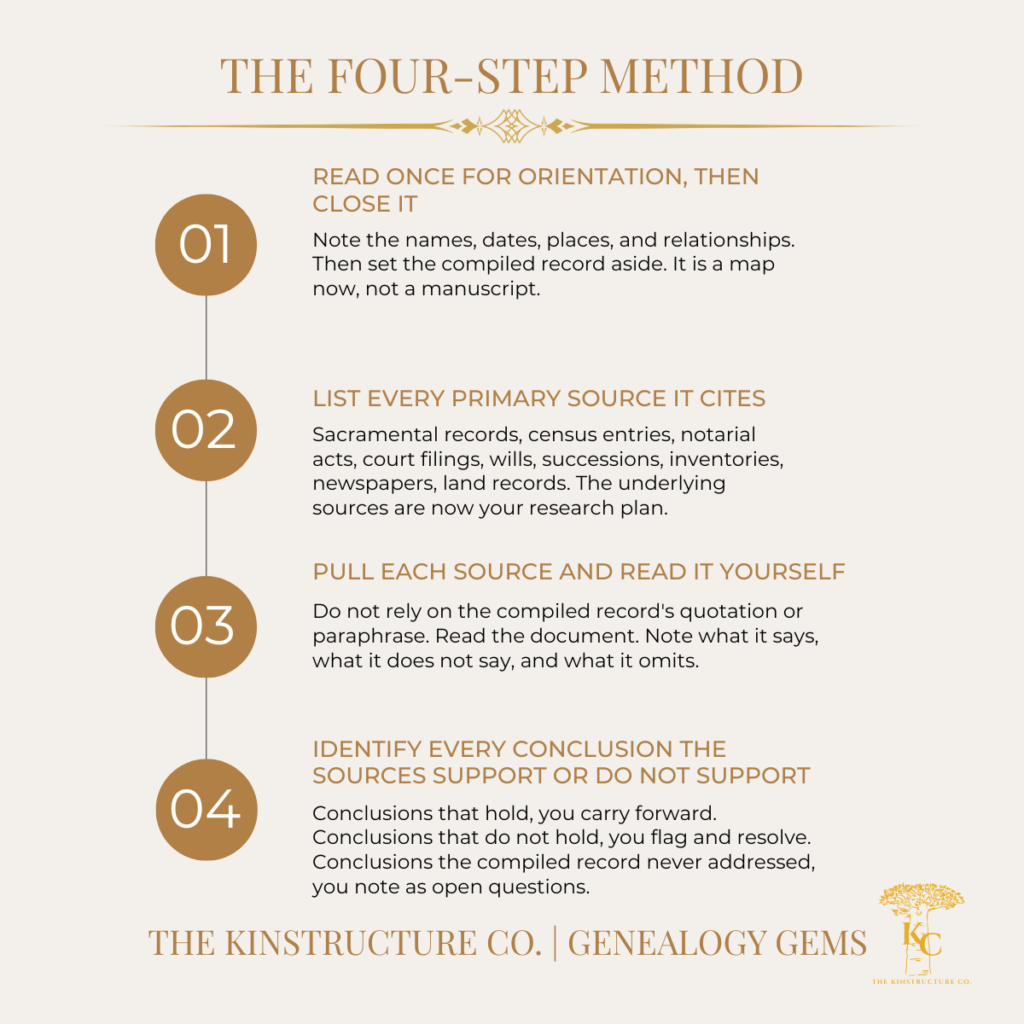
Step One: Read the Compiled Record Once for Orientation, Then Close It
Read it first to understand what the researcher claims and what evidence they say supports the claim. Note the names, dates, places, and relationships. Then set it aside. The compiled record is now a map, not a manuscript. You are about to walk the territory it describes, and you cannot do that while you are still reading their description of it.
Step Two: Build a Separate List of Every Primary Source the Compiled Record Cites
Every sacramental record. Every census entry. Every notarial act. Every court filing. Every will, succession, or inventory. Every newspaper notice. Every land record. Whatever the compiled record cites, you list separately, with the full citation as the researcher gave it. This list is now your research plan. The compiled record’s narrative is no longer driving the work. The underlying sources are.
Step Three: Pull Each Primary Source Independently and Read It for Yourself
This is the step most researchers skip and the step that separates verified work from inherited work. Pull the sacramental register entry and read it. Pull the notarial act and read it. Pull the succession inventory and read it. Do not rely on the compiled record’s quotation or paraphrase. Read the document. Note what it says, what it does not say, and what it says that the compiled record did not mention.
Step Four: Identify Every Conclusion in the Compiled Record That the Primary Sources Do or Do Not Support
Some conclusions will hold. The documents will say what the researcher said they said. Some will not. The documents will be ambiguous where the compiled record was certain. The documents will be silent where the compiled record was confident. The documents will sometimes contradict the compiled record entirely. Your job is to document each one. Conclusions that hold, you carry forward. Conclusions that do not hold, you flag and resolve. Conclusions the compiled record never addressed, you note as open questions.
The Method in Practice
The Women’s History Wednesday feature published on April 15 documented the life of Marguerite, the subject of the 1782 Margarita Case in colonial Louisiana. That post was built using this exact four-step method. The starting point was a compiled record produced by another researcher whose full citation will appear in a future installment.
The Guillory Inventory drawn on July 2, 1764, at the Guillory habitation at Mobile Bay was pulled independently. The inventory lists nine enslaved persons. Marguerite appears as a Negress, pregnant, aged 35 to 40, valued at 400 piastres. The document was read directly. The valuation, the pregnancy, and the age range were confirmed against the original colonial record rather than inherited from the compiled record’s paraphrase.
The April 13, 1770 act of emancipation drafted by a local schoolmaster at Opelousas Post was pulled and read. The document was confirmed to be technically invalid as originally drawn because the schoolmaster was not legally qualified to officiate at a manumission. The compiled record had cited this fact. Independent reading of the document and its procedural context confirmed it.
The 1782 court filing in the Spanish colonial archive at New Orleans was pulled. The legal regime shift from French colonial law to Spanish law, drawn from the Siete Partidas, was confirmed through published colonial legal scholarship rather than through the compiled record alone.
The result was a documented record that stood on the primary sources, with the compiled work credited as the research map and the underlying documents credited as the evidence.
Why This Matters
When another researcher has done careful work before you, honor it by verifying it. The strongest tribute you can pay a researcher whose compiled record opened a door for you is to walk through that door and confirm what they found, not to take their word for it.
Reading the documents yourself means citing what you read, not what someone else told you was in the document.
This is also the difference between research and repetition. Reading the documents yourself means citing what you read, not what someone else told you was in the document. It means noticing when the compiled record and the underlying document disagree, and documenting how you resolved the difference. It means treating your ancestor’s record as evidence to be weighed rather than as a story to be retold.
She is in the record. Make sure you are reading the record, not someone else’s reading of it.
Who ya’ people? ⚜️
Bibliography
Act of Emancipation, Gregoire Guillory and Marguerite. April 13, 1770. Opelousas Post, Louisiana.
De Ville, Winston. Mobile Bay and the Guillory Inventory of 1764. 2003.
De Ville, Winston. Opelousas Post: The Census Reports of 1771. 1983.
Guillory Inventory. July 2, 1764. Guillory habitation, Mobile Bay. Colonial Louisiana inventory record.
Margarita v. Guillory et al. 1782. Spanish Colonial Judicial Records, Cabildo Archives, New Orleans.
Sturgell. The Margarita Case manuscript. Louisiana lineage research.