GENEALOGY GEMS· Genealogy Research
When the Document Did Not Say What They Said It Said: Reading Primary Text Against Advocacy Interpretation
A four-step method for reading primary text against advocacy interpretation
By The Kinstructure Company · June 4, 2026 · 14 min read
When you find a primary document that someone has been quoting for two hundred years, the temptation is to accept what they say it means. That is not research. That is repetition.
Primary documents say what they say. What later litigants, descendants, advocates, and historians argue they meant is a separate question. A serious researcher reads the document first, in its own language and on its own terms, and then separately documents the arguments that have been built on top of it. Conflating those two steps is one of the most common errors in family history research, and it is the error that converts careful documentation into inherited claim.
This installment introduces a four-step method for reading a primary document against the advocacy interpretation that has accumulated around it.
Primary documents say what they say. What later parties argue they mean is a separate question.
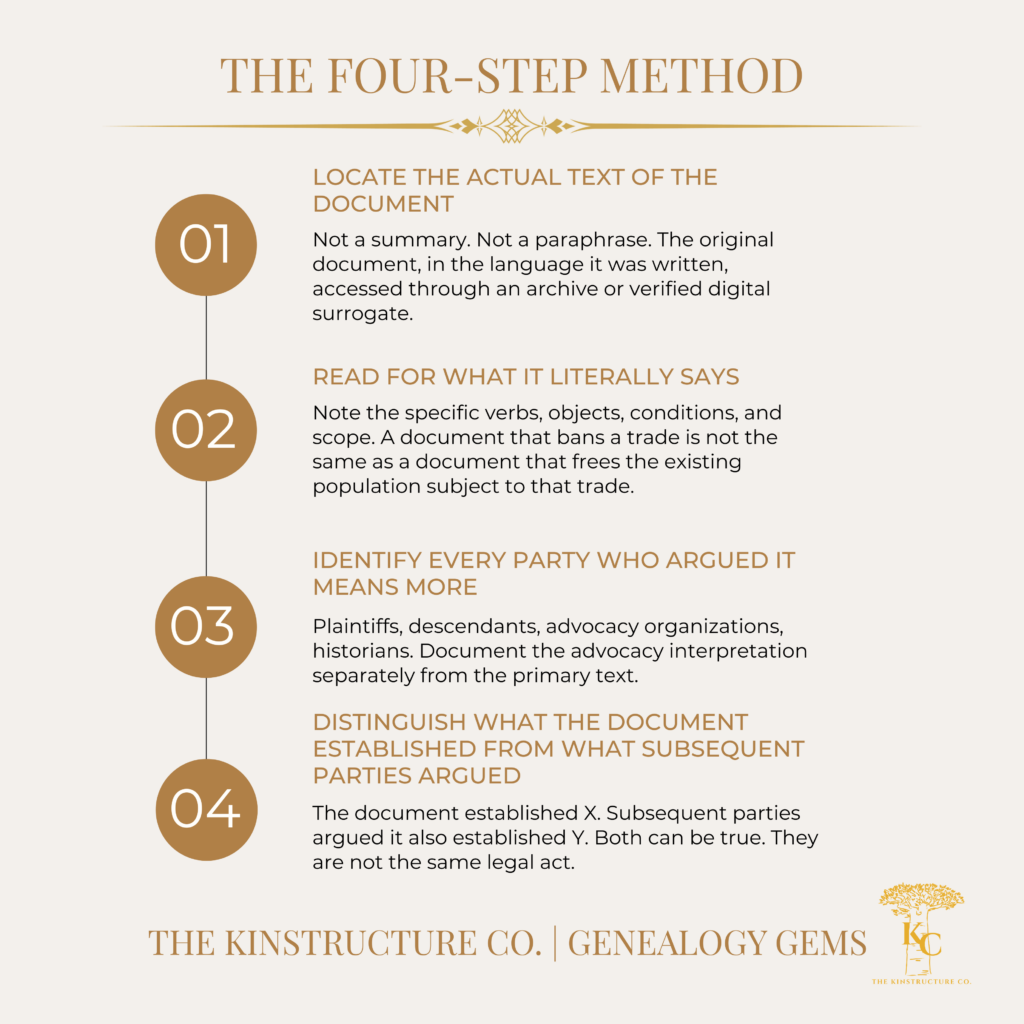
Step One: Locate the Actual Text of the Document
Not a summary. Not a paraphrase. Not someone else’s translation of it. The original document, in the language it was written, accessed through an archive, a published primary source compilation, or a verified digital surrogate. If the document is in a language you do not read, find a published translation by a credentialed translator rather than relying on a litigant’s or a popular history’s rendering of what it says.
Step Two: Read the Document for What It Literally Says
Note the specific verbs, the specific objects, the specific conditions, and the specific scope. A document that bans the trade in something is not the same as a document that frees the existing population subject to that trade. A document that requires a registration is not the same as a document that creates a status. A document that authorizes an action is not the same as a document that compels it. Read for the precise legal effect, not for the moral implication.
Step Three: Identify Every Party Who Has Later Argued the Document Means More Than Its Text Supports
Plaintiffs in subsequent litigation. Descendants. Advocacy organizations. Historians writing for a popular audience. Lineage society applications. Each of these has a stake in what the document is understood to mean, and that stake shapes how they read it. Document the advocacy interpretation separately from the primary text. Both belong in the research file. They do not belong in the same paragraph.
Step Four: Distinguish What the Document Established Legally from What Subsequent Parties Argued It Should Be Read to Establish
This is the discipline that separates documented history from inherited claim. The document established X. Subsequent parties argued it also established Y. The case for Y rests on the strength of the legal argument and the courts that accepted it, not on the text of the original document. Both can be true. The original document said X. The later legal proceedings argued and sometimes successfully established Y based on that X.
The Method in Practice
The Women’s History Wednesday feature published on May 13 documented the life of Marguerite Scypion, a woman of Natchez descent whose 1825 to 1838 freedom suit against the Chouteau family of St. Louis rested on a 1769 proclamation issued by Don Alejandro O’Reilly, Spanish Governor of the Province of Louisiana. The Scypion plaintiffs argued that the O’Reilly proclamation freed their grandmother Marie Jean Scypion and her descendants. The cases that followed, Marguerite v. Chouteau in 1834 and Chouteau v. Marguerite in 1838, established their freedom in American courts.
The four-step method applied to that case surfaced the following.
The actual text of the O’Reilly proclamation, accessed through the Historic New Orleans Collection, banned the trade in Indian slavery in the Province of Louisiana. The proclamation prohibited Spanish subjects from buying, selling, or trading Indian captives going forward.
What the proclamation literally said was a prohibition on future commerce. What it did not literally say was that all existing Indian captives in the Province were thereby freed. The legal effect of the proclamation, on its text, was prospective rather than retroactive.
The parties who later argued the proclamation should be read to free existing captives were the Scypion plaintiffs themselves, beginning in 1825. Their argument was that a proclamation banning the trade necessarily voided the legal basis for the captivity that the trade had created. That argument was a legal interpretation built on top of the proclamation’s text, not a restatement of what the proclamation literally said.
The American courts that heard Marguerite v. Chouteau in 1834 and Chouteau v. Marguerite in 1838 accepted enough of the Scypion argument to rule in their favor. The freedom of the Scypion descendants was established in American courts in 1838. That ruling was a legal victory built on a sustained advocacy interpretation of a Spanish colonial proclamation that, on its text, did not directly grant what the courts ultimately granted.
The proclamation banned a trade. The courts freed a family. Both are true. They are not the same legal act.
Why This Matters
The proclamation banned a trade. The courts freed a family. Both are true. They are not the same legal act, and they should not be described as if they were.
When a researcher documents Marguerite Scypion’s case, the discipline is to credit the proclamation for what it banned and the courts for what they granted. Conflating the two flattens the legal history and erases the work that the Scypion plaintiffs themselves did across thirteen years of litigation to convert a prospective prohibition into a retroactive emancipation.The document is the document. The argument is the argument. The ruling is the ruling. Reading them as three distinct sources is the discipline that turns inherited history into documented history.
Who ya’ people? ⚜️
Bibliography
Banner, Stuart. The Death Penalty: An American History. Cambridge: Harvard University Press, 2002.
Chouteau v. Marguerite, 37 U.S. 507 (1838).
Ekberg, Carl J. Stealing Indian Women: Native Slavery in the Illinois Country. Urbana: University of Illinois Press, 2007.
Foley, William E. “Slave Freedom Suits before Dred Scott: The Case of Marie Jean Scypion’s Descendants.” Missouri Historical Review 79, no. 1 (October 1984): 1-23.
Marguerite v. Chouteau, 3 Mo. 540 (1834).
O’Reilly, Don Alejandro. Proclamation banning the trade in Indian slavery, Province of Louisiana, 1769. Historic New Orleans Collection, THNOC 67-28-L.
VanderVelde, Lea. Redemption Songs: Suing for Freedom Before Dred Scott. New York: Oxford University Press, 2014.