Genealogy Gems · Genealogy Research
Reading the Estate Notice: Reconstructing Enslaved Families in St. Landry Parish, 1856
What the record intended to erase, the research restores.
By The Kinstructure Company · june 2, 2026 · 5 min read
Not every historical record was created to preserve identity. Some were created to transfer property. Understanding that distinction is the first step in learning how to use them.
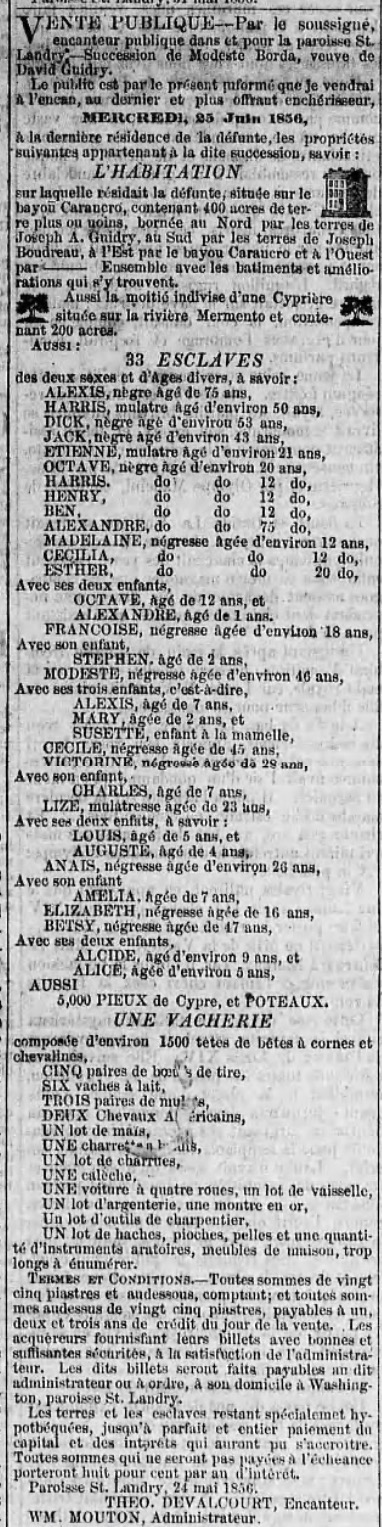
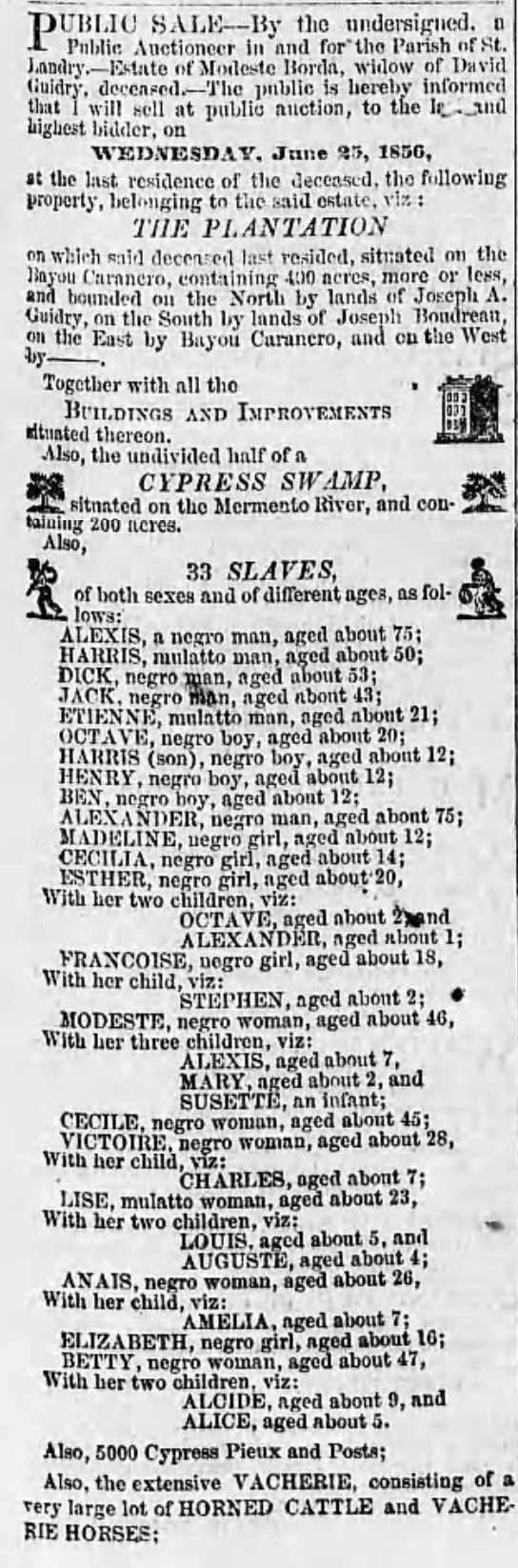
In The Opelousas Patriot dated June 7, 1856, a public sale notice announces the liquidation of the estate of Modeste Borda, widow of David Guedry, in St. Landry Parish. The auction, scheduled for June 25, 1856, includes land on Bayou Carencro, livestock, tools, household goods, and thirty-three enslaved individuals listed by name and age.
The structure of the notice reflects the legal system of the time. Under Louisiana civil law, enslaved people were classified as movable property and were recorded within the same inventory as land improvements and agricultural assets. The record does not separate human lives from material goods. It places them within the same framework of valuation and transfer.
This reality requires careful interpretation.
Each individual is listed with an approximate age. Several women are listed with children using phrases such as “with her child” and “with her two children.” These entries provide strong evidence of maternal association within the enslaved community on that plantation. They are not incidental. They are among the most important clues available for reconstructing family structure prior to emancipation.
Seven Families in a Single Document
Within this single notice, multiple family units can be identified:
- Esther, listed with two children (Octave, aged about 2, and Alexander, aged about 1)
- Francoise, listed with her child Stephen, aged about 2
- Modeste, listed with three children (Alexis, aged 7; Mary, aged 2; and Susette, an infant)
- Victorine, listed with her child Charles, aged about 7
- Lize, listed with two children (Louis, aged about 5, and Auguste, aged about 4)
- Anais, listed with her child Amelia, aged about 7
- Betty, listed with two children (Alcide, aged about 9, and Alice, aged about 5)
Method Matters
This is where method matters.
The newspaper is a derivative source. It reflects an underlying legal proceeding, likely a succession file and notarial sale. Ages are approximate. Names repeat across individuals. Identity cannot be assigned based on name alone. Each person must be analyzed within a cluster of associated individuals, location, and timeline.
Identity cannot be assigned based on name alone.
The terms of sale provide additional context. Purchases over twenty-five dollars were made on credit, payable over one, two, and three years. The notice states that the property, including the enslaved individuals, remained mortgaged until full payment. This is direct evidence that enslaved people functioned not only as labor assets but also as financial collateral within a structured credit system.

What This Record Provides
For genealogical research, this record provides:
- Named individuals prior to emancipation
- Estimated birth ranges based on listed age
- Identifiable maternal groupings
- A fixed geographic location on Bayou Carencro, St. Landry Parish
- A defined slaveholding estate tied to the Borda and Guedry families
Where to Go Next
The next phase of research should focus on correlation across multiple record types:
- Succession and probate records in St. Landry Parish
- Notarial acts documenting the sale or division of the estate
- Catholic sacramental registers for baptisms, marriages, and burials
- Freedmen’s Bureau labor contracts and records after 1865
- The 1870 federal census, where formerly enslaved individuals appear by name for the first time
When these sources are analyzed together, continuity can be established. A child listed in 1856 may appear as an adult in 1870. A maternal grouping may persist as a household unit after emancipation. This is how fragmented records become traceable families.
This is how fragmented records become traceable families.
Records like this are difficult because of what they represent. They were not created to preserve identity, yet they contain some of the most critical information available for those seeking to trace enslaved ancestry.
For descendants of these communities, this type of record can serve as a point of entry. It provides names, relationships, and place at a time when documentation is limited. When approached with discipline and supported by multiple sources, it allows individuals to begin reconstructing lineages that were disrupted and obscured.
This work requires precision. It also requires purpose. The goal is not only to document, but to restore connection where the record once reduced people to property.
The goal is not only to document, but to restore connection where the record once reduced people to property.
Bibliography
“Public Sale: Estate of Modeste Borda, Widow of David Guedry.” The Opelousas Patriot (Opelousas, La.), June 7, 1856. Digital image. Newspapers.com.
Researchers Note
The newspaper is a derivative source. The underlying succession and notarial records in St. Landry Parish should be consulted to verify names, ages, and relational groupings. Ages listed in sale notices are approximate. Conflicting sources should be noted in the research file rather than resolved by assumption.