Genealogy Gems· Genealogy Research
Genealogy Gems, Genealogy Research, Louisiana Heritage, Research Methodology
A four-step method for reading Spanish colonial notarial acts as biographical sources.
By The Kinstructure Company ·june 25, 2026 · 7 min read
The Spanish colonial notarial archive in New Orleans holds one of the most underused biographical record sets in Louisiana genealogy. Researchers approach the archive looking for land transactions and miss the rest of what it contains. The notarial acts of late eighteenth and early nineteenth century Louisiana documented far more than property. They documented credit, debt, manumissions, partnerships, marriages contracts, dowries, estate divisions, partitions, mortgages, sales of every kind of asset, and the formal economic relationships that bound households together across the city.
For free women of color in Spanish colonial Louisiana, the notarial archive is often the single most concentrated source of biographical evidence available. A free woman of color who appears as a seller, a buyer, a witness, an executor, a party to a manumission, a creditor, a debtor, or a holder of a security interest is leaving a biographical trail every time she appears. The discipline is learning to read the act as a biographical document, not just as a legal instrument.
This installment introduces a four-step method for reading Spanish colonial notarial acts as biographical sources.
For free women of color in Spanish colonial Louisiana, the notarial archive is often the single most concentrated source of biographical evidence available.
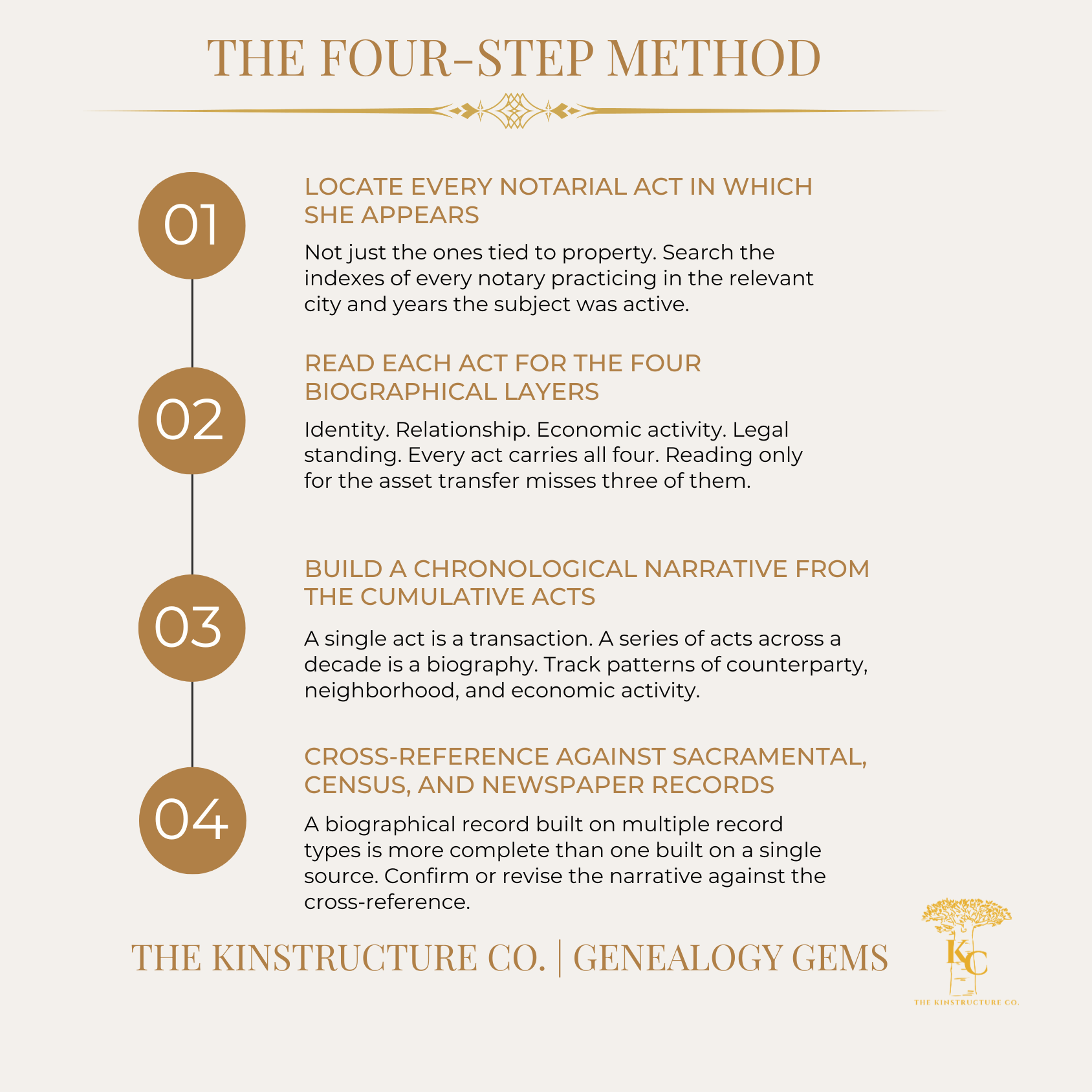
Step One: Locate Every Notarial Act in Which the Subject Appears
Search the indexes of the notarial protocols by surname across every notary practicing in the relevant city and the years the subject was active. The New Orleans Notarial Archives holds the protocol books of all notaries who recorded acts in the city under both Spanish and early American rule. A free woman who lived in New Orleans for thirty years may appear in the books of five or six different notaries depending on which neighborhood she lived in, who her transactional counterparties were, and which notary held the practice she preferred. Do not search only one notary. Search the indexes of all of them.
Step Two: Read Each Act for the Four Biographical Layers
The first layer is identity. The act names her by name, often with her racial designation, her free status, her parish of residence, and sometimes her parents or her late husband. The second layer is relationship. The act names her counterparties, her witnesses, her executors, and the parties whose interests her transaction touched. The third layer is economic activity. The act names the asset being transferred, the price, the terms of payment, and the security interest if any. The fourth layer is legal standing. The act records whether she signed in her own name, whether she required a curator or a husband’s authorization, and whether she was acting as principal or as agent for another party.
Every notarial act carries all four layers. Reading only for the asset transfer captures one layer and misses the other three.
Step Three: Build a Chronological Narrative from the Cumulative Acts
A single notarial act is a transaction. A series of notarial acts across a decade or more is a biography. Track every appearance chronologically. Note who she did business with repeatedly. Note where she lived across the years. Note when her economic activity expanded or contracted. Note when her counterparties changed. The chronological narrative reveals patterns that no single act would surface.
Step Four: Cross-Reference Against Sacramental, Census, and Newspaper Records
Notarial acts establish economic and legal facts. Sacramental records establish religious and familial facts. Census entries establish residential and household facts. Newspaper notices establish public and commercial facts. A biographical record built on all four record types is far more complete than a record built on any one of them. Where the records confirm one another, the narrative is strong. Where they contradict one another, the conflict is preserved in the research file and noted as an unresolved question.
The Method in Practice
The Women’s History Wednesday feature published yesterday documented the life of Francisca “Fanchon” Montreuil, a free woman of color who worked as a baker in Spanish colonial New Orleans across the late eighteenth and early nineteenth centuries. The biographical record rests on her appearance in the notarial acts of New Orleans across twelve years, from 1790 to 1802, supplemented by the 1803 estate sale notice that appeared in Moniteur de la Louisiane.
The four-step method applied to her case surfaced the following.
The notarial acts in which she appears were located across multiple notaries’ protocol books at the New Orleans Notarial Archives. She did not transact with a single notary across her career. She appeared in the books of several practicing notaries over the twelve-year span, which is itself a biographical detail. A woman who moves between notaries is often a woman whose business is substantial enough to warrant the relationships, or a woman whose neighborhood and counterparties shifted over time.
The acts read for the four biographical layers established her as a free woman of color recorded by name and racial designation in every act, a party to credit and debt relationships with named counterparties across the city, a baker whose economic activity appeared in transactions tied to ovens, flour purchases, and the sale of baked goods, and a legal actor who signed acts in her own name without curator or husband’s authorization.
The chronological narrative built from the cumulative acts revealed a baker operating a sustained commercial business across more than a decade in colonial New Orleans, with property holdings, credit relationships, and a documented economic footprint across the city.
The cross-reference against the 1803 estate sale notice in Moniteur de la Louisiane closed the narrative arc. The estate sale notice documented the disposition of her assets after her death and confirmed the economic standing the notarial acts had established.
The notary’s hand recorded her life. The researcher’s job is to read it.
Where to Access These Records
The protocols of the Pedro Pedesclaux notary’s office in New Orleans, which span 1788 to 1816 and cover the years Francisca Montreuil was transacting, are digitized and publicly accessible at no cost through the Orleans Parish Civil District Court Clerk’s office. The full list of New Orleans notaries from 1731 to 1970, including indexes for many of their protocols, is hosted at the same office. Diaspora researchers who cannot get to New Orleans physically can access the records from anywhere.
Pedro Pedesclaux notarial protocols: https://www.orleanscivilclerk.com/pedesclaux.htm
Full New Orleans notaries index: https://www.orleanscivilclerk.com/Notaries/lista.htm
Why This Matters
A free woman of color who appears once in a notarial act has left one biographical data point. A free woman of color who appears across twelve years of notarial acts has left a documented life. The biography is in the archive. The discipline is learning to read for it.
This installment opens the Genealogy Gems methodology series into archival reading as a discipline distinct from documentary recovery, compiled research, or court records. Future installments will extend the same archival discipline into sacramental record reading, ecclesiastical court records, French colonial notarial protocols, and contemporaneous newspaper notices in colonial Louisiana papers. The methodology series is becoming a recognizable curriculum on Louisiana colonial archival research.
The notary’s hand recorded her life. The researcher’s job is to read it.
Who ya’ people? ⚜️
Bibliography
“Estate sale notice for Francisca Montreuil.” Moniteur de la Louisiane, 1803.
Hanger, Kimberly S. Bounded Lives, Bounded Places: Free Black Society in Colonial New Orleans, 1769-1803. Durham: Duke University Press, 1997.
New Orleans Notarial Archives. Spanish colonial notarial protocols, 1790-1803. New Orleans, Louisiana.
Orleans Parish Civil District Court Clerk. “Notaries 1731-1970.” Index of New Orleans notaries with digitized protocols. New Orleans, Louisiana. https://www.orleanscivilclerk.com/Notaries/lista.htm.
Orleans Parish Civil District Court Clerk. “Pedro Pedesclaux Notarial Protocols, 1788-1816.” Digitized indexes. New Orleans, Louisiana. https://www.orleanscivilclerk.com/pedesclaux.htm.
Spear, Jennifer M. Race, Sex, and Social Order in Early New Orleans. Baltimore: Johns Hopkins University Press, 2009.