• Skip to main content

The Kinstructure Company

  • Home
  • About
  • Kinstructure™ Products and Services
    • Kinstructure Kinnect
    • Kinstructure Magazine
    • Custom Services
  • Shop
  • Contact Us
  • Policies & FAQ
    • Terms and Conditions
    • FAQ
  • Blog

Louisiana Creole genealogy

Marguerite and the Margarita Case: A Legal History of One Woman’s Fight for Her Children in Colonial Louisiana, 1764–1808

April 15, 2026 by The Kinstructure Company

Women’s History Wednesday · Genealogy Research

Marguerite and the Margarita Case

One woman’s fight for her children in colonial Louisiana, 1764 to 1808.

By The Kinstructure Company · April 15, 2026 · 14 min read

There is a woman at the center of one of the most consequential legal cases in colonial Louisiana history. Her name was Marguerite. She was born in Africa. She was transported across an ocean, held in bondage in colonial Louisiana, given a fraudulent emancipation, re-enslaved by legal instrument, abducted at knifepoint, imprisoned in New Orleans, and required to purchase the freedom of her own children in open court.

She filed her own lawsuit in 1782. She navigated Spanish colonial law across multiple jurisdictions. She produced certified documentary evidence before a high court. She won legal standing, enforcement orders, and ultimately the freedom of four children.

She is cited in two centuries of legal proceedings, from the Cabildo in New Orleans to a 1982 case covered by national newspapers.

Marguerite is my sixth great-grandmother. The pedigree tracing my descent from her through Jean Baptiste Guillory, Donato Guillory père, Elisabeth Guillory, and the Bello line of Saint Landry Parish is documented and privately held. I am publishing this record because she has never received one that treats her as the subject rather than the object. That changes today.

This is a documented account of her life and legal record, drawn from primary source court records, colonial inventories, and peer-reviewed genealogical scholarship.

The legal record, 1727 to 1808

c. 1727

Marguerite born in Africa.

1764

Appears in Guillory Inventory, Mobile Bay. Pregnant. Highest valuation of any enslaved woman in the inventory.

1770

Private act of emancipation. Deliberately defective. Cured by notarial recording in New Orleans.

1773

Re-enslaved by inventory. Paper freedom ignored.

1777

Abducted at knifepoint. Freed again before Gregoire Guillory’s death.

1781

Imprisoned in New Orleans. Produces the 1770 document. Freedom confirmed.

1782

Files Case No. 3440 before Alcalde Panis. Wins freedom of four children.

1808

Final documentary appearance. Daughter Marie marries. Both listed as free.

1982

Case records introduced as state evidence in Phipps v. Louisiana racial classification suit.

The Legal World Marguerite Entered

The Gulf South in the mid-eighteenth century was a corridor of competing colonial jurisdictions. France had governed Louisiana under its own civil law tradition. The Code Noir of 1724 regulated the conditions of slavery under French Louisiana and placed procedural constraints on manumission. When France transferred Louisiana to Spain in 1762 under the Treaty of Fontainebleau, and the transfer became publicly effective in 1769, the legal regime governing enslaved persons shifted substantially.

Spanish colonial law, drawn from the Siete Partidas and subsequent colonial legal codes, recognized the capacity of enslaved persons to petition courts, submit evidence, purchase freedom, and appeal adverse decisions through a multi-level judicial hierarchy extending from local commandants to provincial courts in New Orleans to the high court in Havana, Cuba (De Ville, 1983, pp. 85–86). The difference between French and Spanish law on the questions of manumission and legal standing would prove decisive in Marguerite’s case.

Marguerite’s enslaver, Gregoire Guillory, was a French colonial settler who had established himself on Dauphine Island near Mobile Bay. His family relocated to Spanish-governed southwest Louisiana after the British occupation of West Florida in 1763. Marguerite traveled with that household, from one legal system into another (De Ville, 2003, pp. 13–17). The second legal system gave her the procedural instruments she needed to fight.

The First Document: The Guillory Inventory of 1764

The oldest document in the Opelousas Post collection at the Louisiana State Archives is the Guillory Inventory drawn on July 2, 1764, at the Guillory habitation at Mobile Bay. It was executed at the request of Sieurs Dupont and Gentils, sons-in-law of Gregoire Guillory, following his wife Marie Jeanne LaCasse’s death in April of that year (De Ville, 2003, pp. 19–24).

Among nine enslaved persons listed, Marguerite appears as a Negress named Marguerite, pregnant, aged 35 to 40, valued at 400 piastres. She carried the highest individual valuation of any enslaved woman in the inventory. The child she carried was Gregoire Guillory’s child. That parentage was never disputed in any subsequent litigation across five years of colonial proceedings (Sturgell, n.d.; De Ville, 1983, pp. 85–88).

The Emancipation of 1770 and Its Deliberate Defect

Following the family’s relocation to Opelousas Post and the births of four children fathered by Gregoire Guillory, he executed a private act of emancipation on April 13, 1770, freeing Marguerite and her children: Catherine (called Catiche, born circa 1764), Jean Baptiste (born circa 1766), Joseph (born circa 1769), and Marie (born circa 1770) (Sturgell, n.d.).

The document was drafted by a local schoolmaster who was not legally qualified to officiate at a manumission under applicable legal requirements. The document as originally drawn was technically invalid.

Winston De Ville, a Fellow of the American Society of Genealogists, analyzed this document directly and reached an unambiguous conclusion: the evidence leaves the distinct impression that Guillory wanted to give Marguerite and her children what they would believe to be freedom while preserving a legal loophole for the future (De Ville, 1983, p. 86).

On December 31, 1770, the emancipation act was recorded before Notary Andres Almonester y Roxas in New Orleans. That notarial recording corrected the procedural deficiency and gave Marguerite a legally enforceable instrument. She could not read the document. She did not know about the original defect. She did not know that the notarial recording had cured it. Both facts became critical to the litigation that followed (De Ville, 1983, pp. 85–87; Sturgell, n.d.).

The Re-Enslavement of 1773

On March 13, 1773, the Guillory Inventory of 1773 was drawn by authority of Gabriel Fuselier de la Claire, Commandant of Opelousas and Attakapas Posts, at the request of Jean Baptiste Guillory, his siblings, and their father. Marguerite, approximately forty-two years old, and her four children were listed together, valued at 2,000 livres (De Ville, 2003, pp. 31–35).

This entry appears three years after the emancipation of 1770. Gregoire Guillory had conveyed Marguerite and her children to his legitimate heirs in settlement of his deceased wife’s estate, treating the 1770 emancipation as void. Marguerite held freedom on paper. The paper was being ignored.

This 1773 inventory document was later introduced as evidence in the 1782 Margarita Case and again in a twentieth-century racial classification lawsuit (De Ville, 1983, p. 87).

The Abduction, the Death, and the Petition

Circa 1777, Gregoire Guillory, approaching death, went at night to the residence of his legitimate children, threatened his son Jean Baptiste at knifepoint, and took Marguerite back. His legitimate children did not resist. He died between 1777 and spring 1778, freeing Marguerite again before his death. He was not listed in the Opelousas Post census of May 4, 1777, though his sons were counted, suggesting he had died before that enumeration (Sturgell, n.d.).

Within weeks of his death, Jean Baptiste Guillory petitioned the Opelousas commandant demanding Marguerite’s return to slavery under the Guillory heirs’ ownership, claiming the 1770 emancipation was invalid. The petition was transferred to the high court of the Cabildo in New Orleans on January 20, 1779, and further transferred to the appellate court in Havana, Cuba due to legal complexity (Sturgell, n.d.).

Imprisonment and the First Judicial Confirmation of Freedom

On January 20, 1781, Claude Guillory filed suit before the Court of Alcalde Jacinto Panis in New Orleans, Case No. 3494, characterizing Marguerite as a runaway slave belonging to the Guillory heirs. Marguerite was then living in New Orleans, employed by a man named Miguel Barre. Both Marguerite and Miguel Barre were arrested and imprisoned.

Marguerite produced the certified copy of the 1770 emancipation document before the court. The court accepted it as proof of her free status. Both were released. Her freedom was judicially confirmed by the finding of the New Orleans court (Sturgell, n.d.; De Ville, 1983, p. 87).

The Lawsuit She Filed: Case No. 3440, 1782

On March 9, 1782, having secured judicial confirmation of her own freedom and having watched her children remain in the physical custody of the Guillory heirs, Marguerite filed affirmative suit before the Court of Alcalde Panis in New Orleans. The case is recorded as No. 3440, 71 pages (Spanish colonial petition manuscripts, Case No. 3440, 1782).

She appeared before the tribunal as a legally free woman of color. She named the Guillory heirs as defendants. She cited the 1770 emancipation and the 1781 judicial confirmation of her own freedom. She testified that her four children were being held by force, treated with cruelty, and were at risk of removal from the court’s jurisdiction to prevent enforcement.

She requested that the commandant at Opelousas be notified and ordered to act, that a compliance deadline be established, that defendants who failed to comply be declared in violation, and that her right to pursue damages be preserved.

She also submitted a procedural enforcement packet directed to Commandant Alexandro De Clouet at Opelousas Post, carrying the petition, the certified emancipation, the court’s authentication, and the formal decree. Without this instrument, the court’s ruling would have been unenforceable at the physical location where her children were held.

The court validated Marguerite’s legal standing as a free woman with the capacity to bring suit on behalf of her children. It accepted the 1770 emancipation as valid. It issued a formal enforcement order to Commandant De Clouet and authorized escalation to the Governor if resistance was encountered (Spanish colonial petition manuscripts, Case No. 3440, 1782; Sturgell, n.d.).

The Last Document: February 23, 1808

Marguerite appears in the documentary record for the last time on February 23, 1808. Her daughter Marie married Juan Mateos of Vera Cruz. Both Marguerite and Marie are identified in the marriage record as free. Marguerite was approximately eighty-one years old.

The date and place of her death are not known (Sturgell, n.d.).

Two Centuries of Consequence: The Phipps Case

The Margarita Case did not close in 1783. In the early 1980s, a Louisiana woman named Susie Guillory Phipps sued the State of Louisiana to be declared white, contesting a state law that required her to be classified as colored because her descent included one thirty-second Negro blood. The state traced her genealogy 222 years to Marguerite. The 1773 Guillory Inventory, the 1770 emancipation document, and the Margarita Case records of 1782 were introduced as evidentiary support for the state’s racial classification of Susie Guillory Phipps.

The courts upheld the classification. The Louisiana legislature repealed the one thirty-second statute in 1983. The appellate courts declined to revisit the Phipps ruling on that basis (De Ville, 1983, p. 88).

Marguerite, born in Africa circa 1727, became the documented evidentiary anchor of a legal proceeding two hundred years after her death. The documents she forced into existence to free her children became the instruments through which her descendants were classified by the state she had fought in order to exist freely within.

She is not a footnote. She is the source.

I know who my people are because Marguerite made sure her children would be free to have people of their own. That is the inheritance she purchased. I carry it.

Who ya’ people?

Images

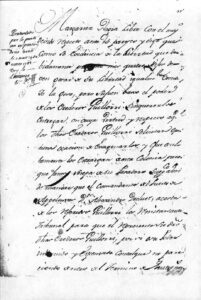
“Margarita Negra libre,” opening page of petition, Case No. 3440, Court of Alcalde Jacinto Panis, New Orleans, 9 March 1782, p. 1. Digital image, Cathy Lemoine Sturgell, comp., My Louisiana Lineage, louisianalineage.com/margaritadoc.htm. Original: Archives of the Cabildo, Louisiana State Museum, New Orleans.
Service notation confirming personal notification to Margarita (Marguerite), free Black woman, Case No. 3440, Court of Alcalde Jacinto Panis, New Orleans, 9 March 1782. Signed: Leonardo Mazange, Escribano. Digital image, Cathy Lemoine Sturgell, comp., My Louisiana Lineage, louisianalineage.com/margaritadoc.htm. Original: Archives of the Cabildo, Louisiana State Museum, New Orleans.
Court order of Alcalde D. Jacinto Panis directing Commandant Alexandro De Clouet at Opelousas Post to remit the four children of Margarita, free Black woman, to the tribunal, invoking the authority of the Governor if necessary, Case No. 3440, 9 March 1782, p. 8. Signed: Jacinto Panis; attested: Leonardo Mazange, Escribano. Digital image, Cathy Lemoine Sturgell, comp., My Louisiana Lineage, louisianalineage.com/margaritadoc.htm. Original: Archives of the Cabildo, Louisiana State Museum, New Orleans.
Petition of Margarita (Marguerite), free Black woman, requesting issuance of formal dispatch to Commandant D. Alexandro De Clouet with insertion of the freedom document, Case No. 3440, Court of Alcalde Jacinto Panis, New Orleans, 9 March 1782. Digital image, Cathy Lemoine Sturgell, comp., My Louisiana Lineage, louisianalineage.com/margaritadoc.htm. Original: Archives of the Cabildo, Louisiana State Museum, New Orleans.
Larking, R.J., comp. “Pedigree Chart No. 1: Georgianna Bello and Collateral Lines.” Prepared 14 April 2026. Privately held by compiler, Texas. Marguerite (enslaved, born Africa, circa 1727) appears as ancestor no. 25; Jean Baptiste Guillory as ancestor no. 12; Elisabeth Guillory as ancestor no. 3.

References:

Brasseaux, C. A., Fontenot, K. P., & Oubre, C. F. (1994). Creoles of color in the Bayou Country. University Press of Mississippi.

De Ville, W. (1983). The Margarita Case: Historical perspectives on a controversial case in 18th century Louisiana. Louisiana Bar Journal, 31(2), 85–88.

De Ville, W. (Ed.). (2003). The Guillory manuscripts, 1764, 1765, 1766, 1773: With a synopsis of early Guillory family history. Provincial Press, Claitor’s Publishing Division. (Original compilation from primary documents; reprint June 2010). ISBN 1-59804-152-5.

Larking, R.J., comp. “Pedigree Chart No. 1: Georgianna Bello and Collateral Lines.” Prepared 14 April 2026. Privately held by compiler, Texas. Marguerite (enslaved, born Africa, circa 1727) appears as ancestor no. 25; Jean Baptiste Guillory as ancestor no. 12; Elisabeth Guillory as ancestor no. 3.

Spanish colonial petition manuscripts, Case No. 3440, Court of Alcalde Jacinto Panis, New Orleans (March 9, 1782). [71 pp.] Archives of the Cabildo, Louisiana State Museum, New Orleans. Petition documents and supporting enforcement instruments compiled at louisianalineage.com/margaritadoc.htm. For the complete case record, see also: Papeles Procedentes de Cuba, General Archives of the Indies, Seville.

Sturgell, C. L. (comp.). (n.d.). Petition manuscripts, Case No. 3440, Court of Alcalde Jacinto Panis, New Orleans, 9 March 1782 [digital images of handwritten Spanish colonial documents]. Guillory Family: The Infamous ‘Margarita’ Case, My Louisiana Lineage. https://louisianalineage.com/margaritadoc.htm — Original documents: Archives of the Cabildo, Louisiana State Museum, New Orleans; Papeles Procedentes de Cuba, General Archives of the Indies, Seville.

Sturgell, C. L. (n.d.). Guillory family: The infamous ‘Margarita’ case. My Louisiana Lineage: Including early Pointe Coupée and Avoyelles colonists and their roots in Canada, France, Germany. Retrieved from louisianalineage.com. [Citing De Ville (1983) and De Ville (Ed.) (2003).]

Vidrine, J. O. (1985). Love’s legacy: The Mobile marriages, 1724–1786. Author.

Vidrine, J. O., & Richardson, E. M. (1981). The Guillorys of Louisiana. La Voix des Prairies, 7, 63–73.

Primary archival sources: Registers of the Cathedral of the Immaculate Conception, Mobile; Opelousas Post and St. Landry Parish civil documents, Louisiana State Archives, Baton Rouge, Louisiana; registers of Saint Landry Catholic Church of Opelousas; Archives of the Cabildo, Louisiana State Museum, New Orleans; church records from France on microfilm at the Family History Library, Salt Lake City, Utah; Papeles Procedentes de Cuba, General Archives of the Indies, Seville, Spain.

Leave a Reply Cancel reply

Your email address will not be published. Required fields are marked *

Filed Under: Genealogy Research, Louisiana History, Women's History Wednesday Tagged With: Colonial Louisiana Free People of Color, Guillory Family Louisiana, Louisiana Creole genealogy, Louisiana Genealogy, Margarita Case 1782, Opelousas history

  • Home
  • About
  • Kinstructure™ Products and Services
  • Shop
  • Contact Us
  • Policies & FAQ
  • Blog

The Kinstructure Company™ LLC · 5900 Balcones Dr. Ste 100 Austin, TX 78731 · Email: support@kinstructure.com · KINSTRUCTURE™ and The Kinstructure Company™ are trademarks of The Kinstructure Company LLC Copyright © 2026